Ever feel like you’re just shouting into the LinkedIn void? Staring at a blank screen, wondering what on earth to post next? You’re not alone. I’ve seen countless brilliant founders and professionals stall their own growth because they treat LinkedIn like an afterthought, posting sporadically whenever an idea strikes.
Let’s be real: random acts of content don’t build an audience. A strategic posting schedule is what turns those fleeting thoughts into a predictable, high-impact content machine. It’s your secret weapon for taming the algorithm and building real trust with your network.
Why a Posting Schedule is Your LinkedIn Superpower
A well-thought-out schedule is the difference between having a meaningful, ongoing conversation with your ideal audience and just making noise. When people know they can count on you for valuable insights on a regular basis, they start to listen. They engage. And eventually, they want to do business with you.
From Chaos to Consistency
Without a plan, posting is purely reactive. You scramble to find something—anything—to share, which usually results in low-effort content that does nothing to move you toward your goals. This is a one-way ticket to burnout.
A schedule gives you a framework. It allows you to batch your content creation, focusing your precious time and mental energy on crafting genuinely valuable material instead of constantly being in "what do I post today?" mode. It's a proactive approach that saves you a ton of stress.
A structured posting schedule is the key to achieving your marketing goals. Posting consistently means showing up in your audience’s feed daily with valuable, unique content. It’s the best way to get noticed by the algorithm and increase engagement.
Building Trust with the Algorithm and Your Audience
Consistency is a massive signal to both the LinkedIn algorithm and the actual humans reading your posts. When you show up reliably, you’re essentially telling the algorithm that you're an active, valuable contributor. In return, it’s more likely to show your content to more people.
At the same time, you’re building a reputation for being a reliable expert with your audience. They learn what to expect from you and when. This structured approach pays off in a few key ways:
- No More Content Scrambles: Planning ahead completely eliminates that last-minute panic of trying to figure out what to publish.
- Guaranteed Content Quality: You give yourself the space to create thoughtful, well-researched posts instead of just rushing to fill a slot.
- You Create Audience Expectation: Your network starts to look forward to your content, which can seriously boost that all-important initial engagement.
Ultimately, a schedule is your public commitment to showing up. It’s the foundation for building authority, fostering a real community, and driving tangible results for your brand. If you want to go even deeper on creating a plan that works for all your platforms, check out this comprehensive guide to creating your best social media posting schedule.
Laying The Groundwork For Your Content Plan
A great social media schedule isn't just a calendar filled with random posts; it’s your strategic map to success on LinkedIn. Before you even think about what to post or when, you have to get brutally honest about why you're even posting in the first place.
Without a clear purpose, you're just adding to the noise.
So, what does success on LinkedIn actually look like for you? Your answer here will dictate every single piece of content you create. Are you trying to generate qualified leads for your consulting business? Maybe your goal is to establish yourself as the undisputed thought leader in your industry. Or perhaps you just want to build a powerful professional network.
Each one of these goals demands a totally different content strategy. Lead generation, for instance, needs more posts pointing to case studies and valuable resources. Building authority, on the other hand, is all about sharing unique insights and personal stories that showcase your expertise.
Once you have a plan, the path to growth becomes surprisingly simple.
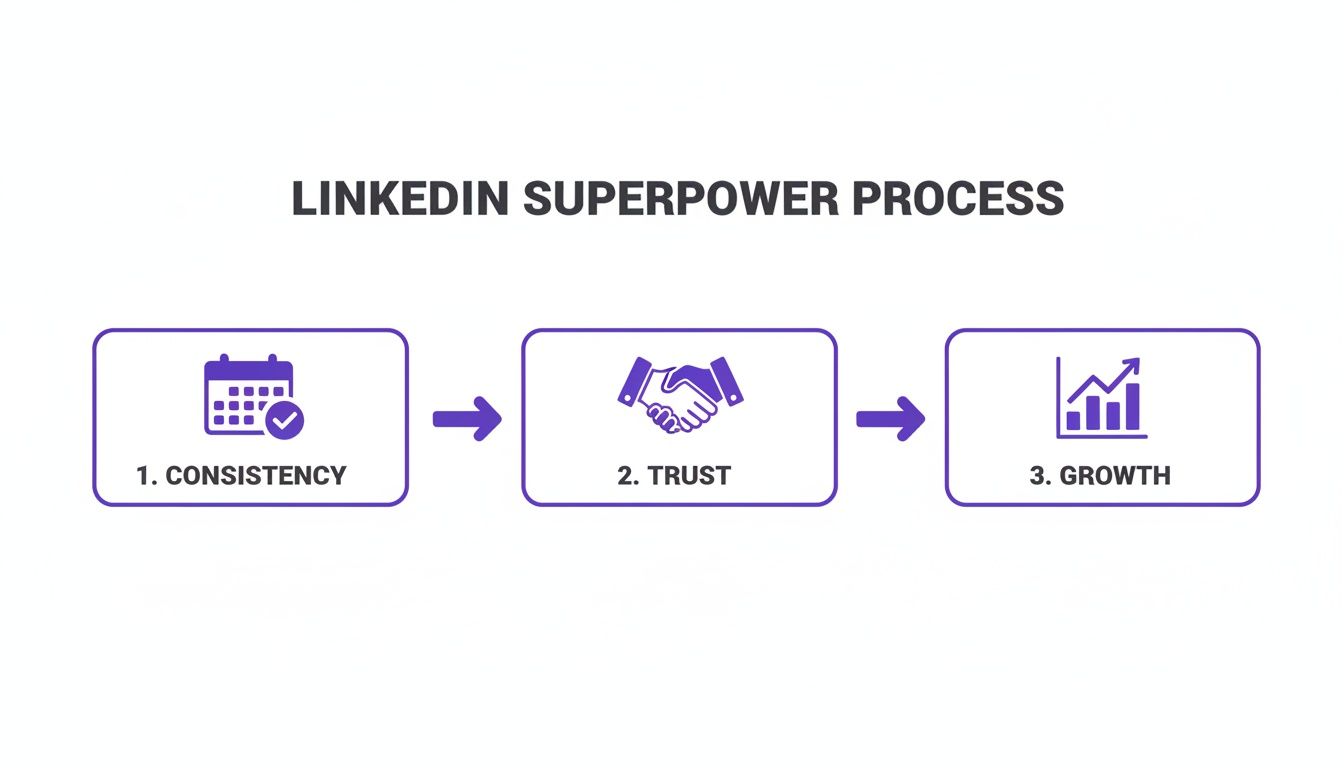
It all boils down to this: consistency builds the trust you need for real, sustainable growth.
Define Your Ideal Audience Persona
Okay, you’ve got your goal. Now, who exactly are you talking to? "Tech executives" is way too broad. You need to get specific and create a persona that feels like a real person you could actually have a conversation with.
Let's imagine you're a B2B sales coach targeting startup founders. Your ideal audience isn't just any founder. It’s the founder who’s up at night worrying about building a repeatable sales process, hiring their first salesperson, or breaking through that early-stage revenue plateau.
That level of detail is everything. It’s what lets you move beyond generic, forgettable content and start addressing the real, nagging problems your audience faces every single day. Your content should feel like the answer to a question they were just thinking about.
Brainstorm Your Core Content Pillars
With your goals and audience dialed in, it's time to map out your content pillars. These are the 3-5 core themes you'll talk about over and over again. They live at the intersection of what your audience desperately needs and where your genuine expertise lies.
Think of them as the main channels of your own personal media company. For our B2B sales coach, the pillars might look something like this:
- Sales Process Engineering: Actionable tips on building a sales funnel that actually works.
- Team Building & Leadership: Stories and advice on hiring, training, and motivating a winning sales team.
- Mindset & Resilience: Personal anecdotes about overcoming the mental hurdles of a sales career.
- Modern Prospecting Tactics: Insights on tools and strategies that get responses today, not a decade ago.
These pillars aren't just topics; they are promises you make to your audience. They set expectations and build a reliable brand, making sure every post reinforces your authority in a very specific niche.
A fantastic way to nail these down is to list out 25 questions your ideal customer asks you all the time. Group those questions into common themes, and you’ll see your core pillars emerge almost automatically. This exercise guarantees your schedule is packed with content that resonates because it’s built on real-world pain points.
From now on, every single post you schedule must tie back to one of these pillars. This focus makes creating content way more efficient and ensures you’re always delivering relevant value. It stops you from chasing random trends and keeps your message sharp, consistent, and incredibly effective. Now you're ready to build a schedule that actually works.
Finding Your Ideal LinkedIn Posting Frequency
When it comes to building a LinkedIn schedule, the first question on everyone's mind is, "How often should I post?" A lot of people fall into the trap of thinking "more is better," but that’s a one-way ticket to burnout and seeing your engagement nosedive. On LinkedIn, consistency and quality will beat high volume every single time.
Believe it or not, posting too often can actually kneecap your reach. It wears out your audience and can even make the algorithm think you're just pushing out spam. The goal isn’t to drown your network’s feed; it’s to become that go-to person they look forward to hearing from.
This is why finding your own posting rhythm is so crucial. You need to strike that perfect balance between staying on people's radar and giving your content enough space to actually get some traction.
Quality Over Quantity: The LinkedIn Sweet Spot
So what’s the magic number? After years in the trenches and looking at the data, a clear sweet spot has emerged for most professionals on LinkedIn: posting between two and four high-quality pieces of content per week. This cadence is just right—it keeps you relevant to the algorithm and your audience without being overwhelming.
Staying consistent within this range is way more powerful than posting in random, chaotic bursts. This steady rhythm teaches the algorithm that you're a reliable source, which pays off with better reach down the line. In fact, people who stick to this pace often see 3-5x higher long-term reach compared to those who post whenever they feel like it.
Think of it this way: a schedule of two to four posts a week is actually manageable. It gives you the time to create thoughtful, well-crafted content that helps your audience, instead of just desperately trying to fill a calendar slot.
A Real-World Example of Posting Frequency
Let’s get practical. Say you're an agency owner trying to land more B2B clients. A frantic, seven-day-a-week posting schedule isn't just overkill—it's pretty much impossible to maintain unless you have a dedicated content team.
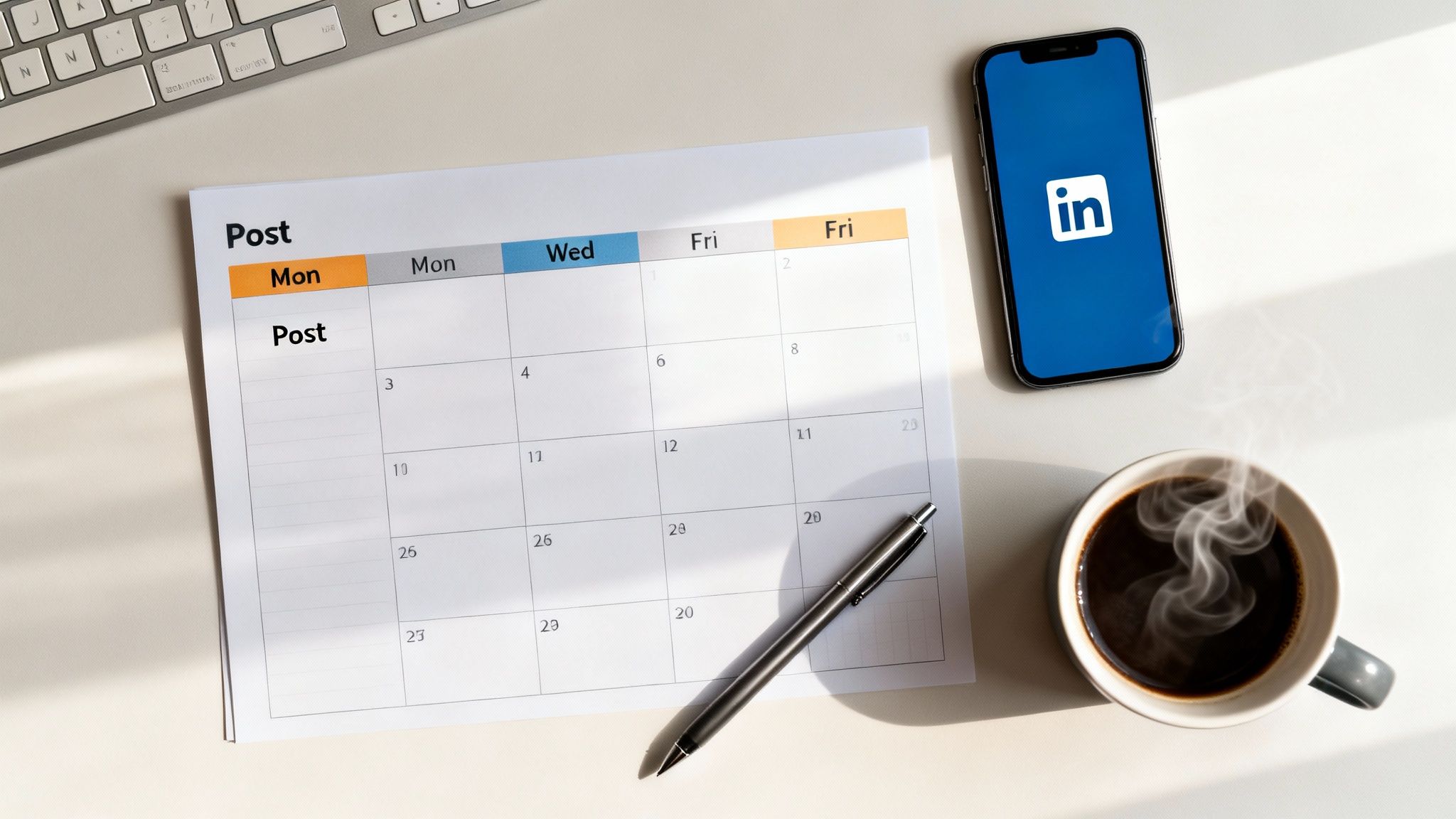
A much smarter, more sustainable schedule might look something like this:
- Monday Morning: Kick off the week by sharing a detailed case study from a recent client win. It immediately shows off your expertise and provides some solid social proof.
- Wednesday Midday: Drop a thought leadership piece. This could be your take on a new industry trend, a contrarian opinion, or a lesson you learned the hard way.
- Friday Morning: Post something quick and engaging, like a helpful tip or a question for your network. It’s a low-effort way to spark conversation and stay visible before the weekend hits.
This three-post-per-week schedule is potent. Each post serves a clear purpose, aligns with your core message, and gives your audience different ways to engage with you.
The key takeaway here is to build your schedule around sustainability and value. A consistent rhythm of high-quality content will always beat a strategy of just posting for the sake of it.
Why This "Less But Better" Approach Works
Adopting this mindset for your LinkedIn frequency gives you a few key advantages. For starters, it respects your audience's time, making them more likely to actually stop and read what you have to say. It also gives each post a longer shelf life, letting it rack up more comments and likes over a few days. For a deeper dive, check out our FAQ on how often you should post on LinkedIn.
This approach also does wonders for your own workflow. By committing to a manageable number of posts, you can pour your energy into making each one great. It’s perfect for content batching—writing your week's posts in one session—which frees you up to focus on, you know, running your business. A strategic and sustainable posting frequency is the absolute bedrock of a successful long-term LinkedIn game plan.
Mastering The Art Of LinkedIn Post Timing
You’ve got your posting cadence locked in, but what about the timing? It’s a detail that’s easy to overlook, but on LinkedIn, when you post can be just as important as what you post.
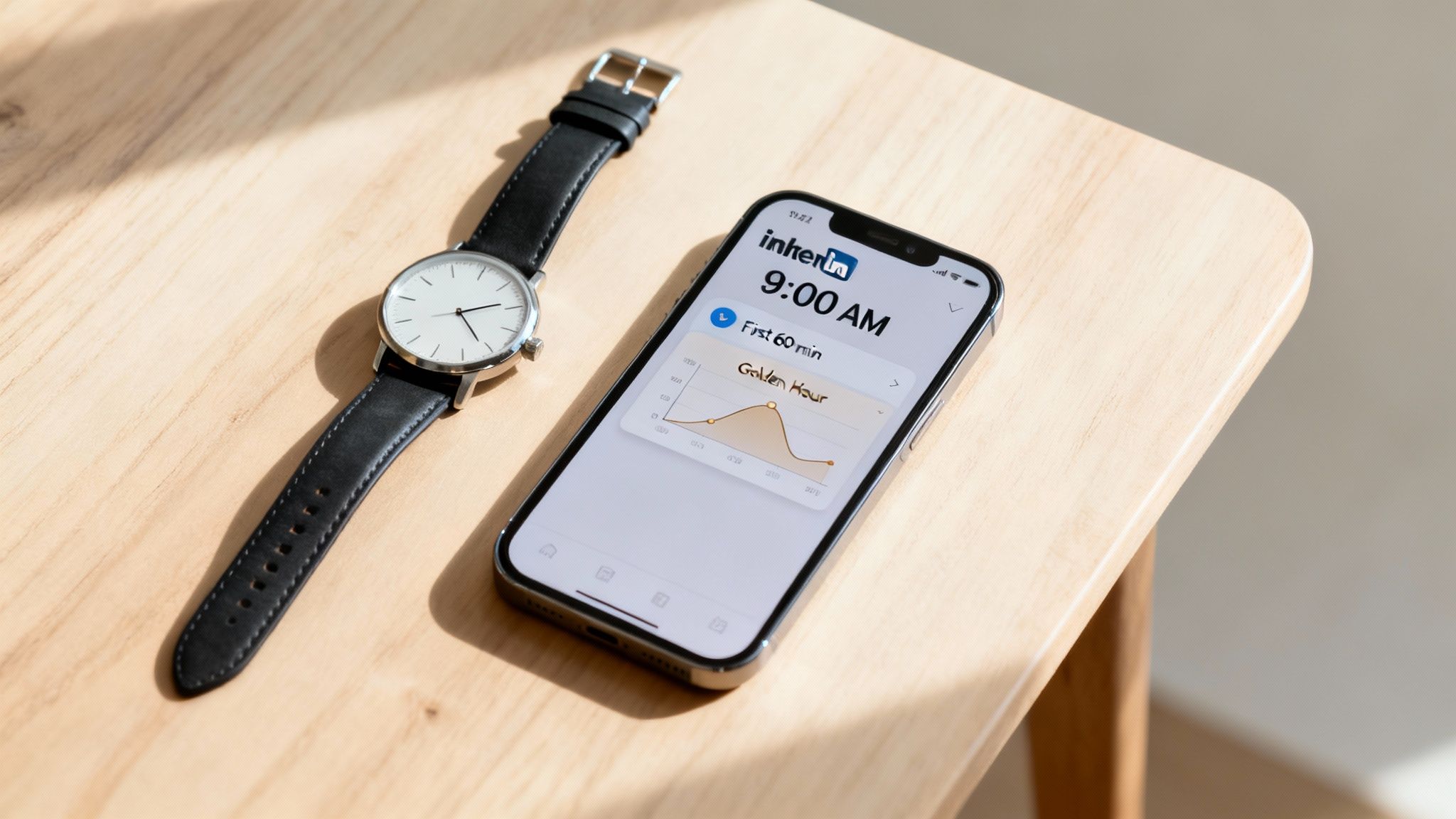
Think of it this way: the LinkedIn algorithm is watching closely the moment you hit “Publish.” It’s looking for quick signals—likes, comments, shares—to decide if your content is worth showing to more people. This initial window, often called the “golden hour,” is your make-or-break moment.
We’re talking about the first 60 to 90 minutes. Strong engagement right out of the gate tells the algorithm your post is valuable, earning it a spot in more feeds. Nail this, and your reach explodes. Miss it, and even the best content can fall flat.
This turns timing from a simple logistical task into a core strategic play. You have to post when your audience is actually online and ready to engage.
Data-Backed Starting Points For Your Schedule
While your audience is unique, we’re not starting from scratch. General data gives us some fantastic clues about when professionals are most active on LinkedIn. They’re usually scrolling at the start of their workday, during their lunch break, or as they wind down in the evening.
Recent analysis points to some specific peak windows during the week. As you build your initial schedule, try plugging these into your calendar:
- Tuesdays & Wednesdays: 10 AM - 12 PM
- Thursdays: 9 AM - 11 AM
These times consistently pop up because they align with common work habits. People have settled in, cleared their morning emails, and are looking for industry insights before lunch.
Why You Need To Think About Your Industry
Generic advice is great, but getting specific gives you a real edge. A teacher’s daily routine is worlds apart from a software engineer’s, and their LinkedIn habits reflect that.
For instance, people in the media world are often online first thing in the morning, hunting for the day's breaking news. On the flip side, someone in higher education might be more active in the late afternoon after their classes are done. For B2B folks, mid-week during core business hours is almost always a safe bet. When figuring out your timing, even research on the best times to post video can offer clues about general platform engagement patterns.
To get you started, here’s a quick breakdown of optimal posting times based on different industries. Use this table as a starting point to form your own hypotheses.
Optimal LinkedIn Posting Times By Industry
| Industry | Best Day(s) | Optimal Time Window (Local Time) |
|---|---|---|
| B2B Services & SaaS | Tuesday, Wednesday, Thursday | 9 AM - 12 PM & 2 PM - 4 PM |
| Media & Publishing | Weekday Mornings | 7 AM - 9 AM |
| Healthcare | Tuesday, Thursday | 10 AM - 2 PM |
| Education | Weekday Afternoons | 2 PM - 5 PM |
| Marketing & Advertising | Tuesday, Wednesday, Thursday | 10 AM - 1 PM |
| Technology (Non-SaaS) | Tuesday, Wednesday, Friday | 9 AM - 12 PM |
Remember, this isn’t gospel. It's an educated guess to get you going. The real goal is to move from broad best practices to personalized, data-driven decisions that reflect what your audience is actually doing.
How To Find Your Personal Peak Posting Times
Industry stats are a launchpad, but the most valuable data will always be your own. Ultimately, you need to figure out when your specific followers are most likely to jump on a post.
Your best friend here is LinkedIn Analytics. Head over to your profile or company page analytics and start digging into post impressions and engagement. Do you see any patterns? Maybe your Wednesday posts consistently get more traction, or perhaps the content you share at 9 AM gets way more comments than anything you post at 3 PM.
To get some clean data, run a simple experiment for a month:
- Pick three time slots to test. Let's say 8 AM, 12 PM, and 4 PM.
- Rotate your posts. For two weeks, post at 8 AM on Mondays, 12 PM on Wednesdays, and 4 PM on Fridays.
- Switch it up. For the next two weeks, reverse the order. This helps you confirm whether it was the time slot or the content itself driving the results.
After a month of this, you’ll have a much clearer picture of your audience's habits. This simple test-and-measure process removes the guesswork. You can dig even deeper with our guide on the best time to post on LinkedIn. Make this a quarterly check-in, and your schedule will evolve right alongside your audience, ensuring every post has the best possible shot at success.
Your Sample Weekly LinkedIn Posting Schedule
Alright, enough with the theory. Let's get practical. A posting schedule isn't just a calendar with times jotted down; it’s the strategic blueprint that breathes life into your content pillars. To show you exactly how this all clicks together, I’ve put together a sample weekly plan for a busy B2B consultant.
Think of this as your launchpad, not a rigid prescription. The idea isn't to copy it verbatim but to use it as a model for your own workflow. Pay attention to how it intentionally mixes different post types and formats. This is key to keeping your audience hooked and avoiding the dreaded "all my posts sound the same" trap.
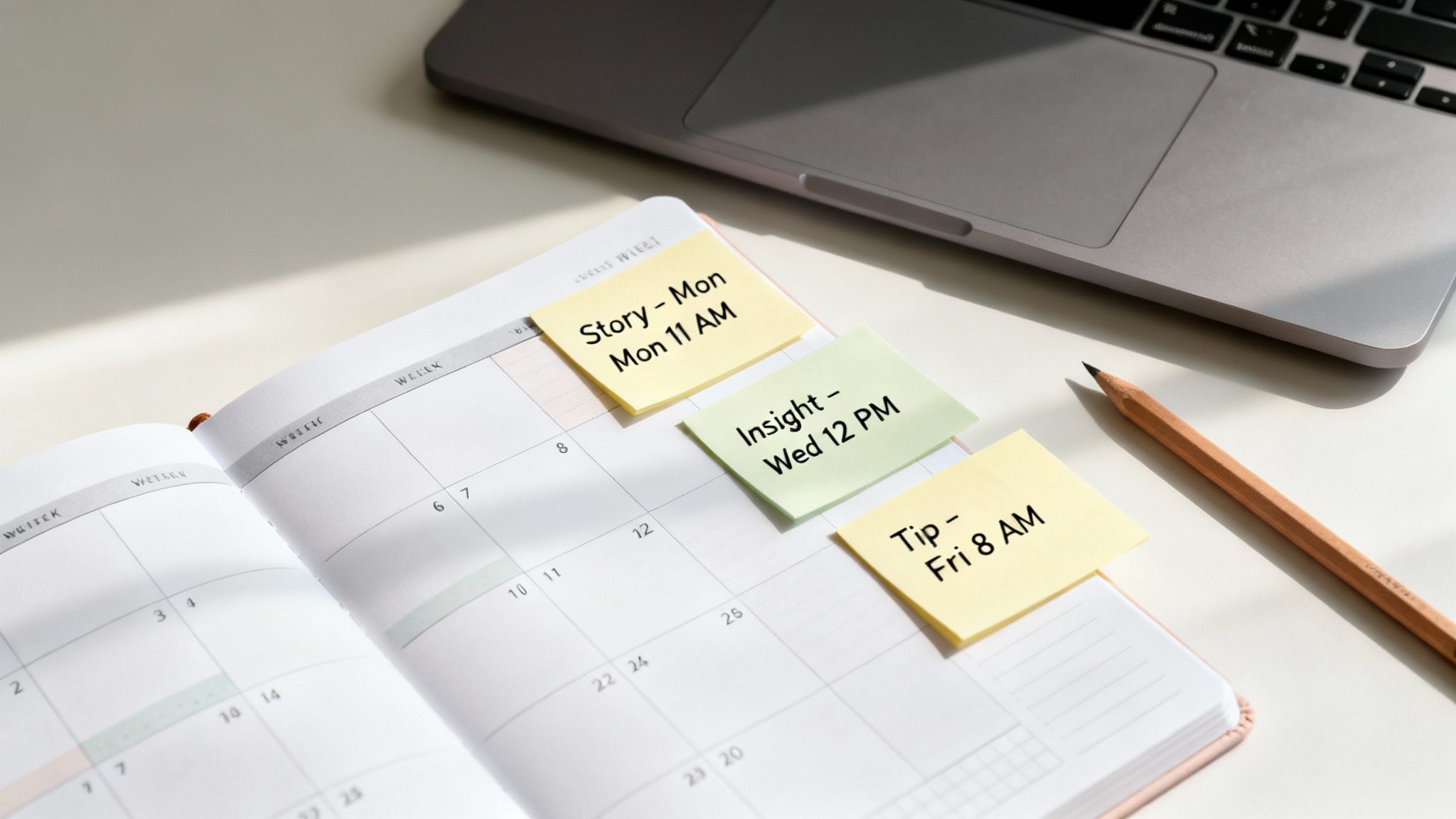
This schedule is built around posting three times per week. From my experience, this hits the sweet spot between staying consistently visible and having enough time to create genuinely valuable content. Quality over quantity, always.
A Look At The Week
Here’s a snapshot of how a B2B consultant could map out their week on LinkedIn to build authority and actually start conversations. Each post is deliberately timed and designed to hit a specific goal within their bigger content strategy.
This approach stops you from just "posting to post." Every single piece of content has a job to do, whether that's building a personal connection, showcasing your expertise, or sparking direct engagement with your network. It's a system built for sustainable impact, not just short-term noise.
Let's break down this sample schedule day by day.
Sample Weekly LinkedIn Posting Schedule For A B2B Consultant
| Day | Time | Content Pillar | Post Format Example |
|---|---|---|---|
| Monday | 11 AM | Personal Story / Lesson Learned | A text-only post sharing a story about overcoming a business challenge. This format feels authentic and encourages comments. |
| Wednesday | 12 PM | Industry Insight / Analysis | A carousel post (PDF) breaking down a complex industry trend into 5 simple slides. This format is highly shareable and establishes authority. |
| Friday | 8 AM | Quick Tip / Audience Question | A single-image post with a quick, actionable tip. End the caption with an open-ended question to drive engagement before the weekend. |
This schedule just works. Why? Because it’s diverse. On Monday, you’re the relatable human. On Wednesday, you’re the sharp expert. By Friday, you’re the helpful guide who starts conversations. That variety keeps your feed feeling fresh and gives your audience multiple reasons to follow and engage.
Why This Structure Works So Well
This sample schedule isn't just a random collection of post ideas. It’s built on a few strategic principles you can swipe for your own plan.
- It Varies Post Formats: Mixing text-only posts, carousels, and single images keeps your feed from getting visually stale. The LinkedIn algorithm also tends to favor creators who use a variety of its native formats.
- It Aligns With Audience Mindset: Think about the weekly rhythm. A reflective personal story lands well on Monday as people are easing into their work. A deep-dive analysis is perfect for midday Wednesday when focus is high. A light, engaging question fits the "almost the weekend" vibe of Friday morning.
- It Is Sustainable: Let's be real—you're busy. Creating three high-quality posts a week is a manageable goal. It allows for batching content without leading to burnout, making it a schedule you can actually stick with for the long haul.
The most effective posting schedules are built for people, not just algorithms. They deliver the right message in the right format at a time when the audience is most receptive to hearing it.
Planning Ahead With A Monthly View
To make this weekly rhythm even easier, zoom out and plan your themes monthly. This is where a simple content calendar becomes your best friend. Before a new month kicks off, decide on one overarching theme.
For instance, a marketing consultant could dedicate an entire month to "Lead Generation."
- Week 1 Theme: Optimizing Landing Pages
- Week 2 Theme: Crafting Compelling Email Sequences
- Week 3 Theme: Leveraging LinkedIn Ads
- Week 4 Theme: Analyzing Campaign Performance
This thematic approach is a game-changer for your workflow. Instead of staring at a blank page each week, you’re just breaking down a bigger topic into smaller, bite-sized pieces. It makes batching your content—writing several posts in one sitting—insanely efficient. You can sit down for a couple of hours and map out an entire week's worth of cohesive content that builds on itself, cementing your expertise in your audience’s mind.
This is how you turn a simple schedule into a powerful content engine.
How To Measure And Adapt Your Schedule For Success
A social media posting schedule isn't a "set it and forget it" kind of thing. I've seen way too many people do this. The real power comes from treating it as a living document—one you constantly tweak based on what the data tells you. This feedback loop is what turns a good schedule into a genuine growth engine.
Your goal here is to stop guessing and start making data-driven decisions. To do that, you need to get comfortable with LinkedIn Analytics. Don't let the wall of numbers intimidate you; just focus on the metrics that actually tell a story about your schedule's performance.
Key Metrics To Track In LinkedIn Analytics
Instead of getting lost in a sea of metrics, I always recommend zeroing in on the ones that directly show how your audience is responding to your content and timing. This is how you spot patterns without getting bogged down by vanity numbers.
For every post, I keep an eye on these three core metrics:
- Impressions: This is simply the total number of times your post was shown to people. A sudden spike or dip can be a huge clue about how the algorithm reacted to your timing, format, or topic.
- Engagement Rate: This is the gold standard. Calculated as
(Likes + Comments + Reposts) / Impressions, it's the truest measure of whether your content actually resonated. A high rate means you nailed it. - Clicks: This tells you how many people took an action—clicking a link, visiting your profile, or hitting the "see more" button. It’s a critical sign that your post is actually driving people to do something.
Tracking these numbers helps you start asking smarter questions. For instance, if a video post gets a fantastic engagement rate but almost no clicks to your website, what does that tell you? The content was compelling, but the call-to-action was probably weak or unclear. That's a real, actionable insight you can use next time.
The most successful pros on LinkedIn don't just post and hope for the best. They analyze, interpret, and adapt. Your data is a roadmap showing you exactly what your audience wants and when they want it.
Simple Scenarios For Iteration
The next step is turning that analysis into action. The easiest way I've found to do this is with simple "if-then" scenarios. This process of continuous improvement is what makes your strategy smarter over time. You can go deeper on this in our detailed guide on how to analyze content performance.
Here are a couple of practical examples from my own experience:
If... your Monday morning posts consistently flop for four weeks straight,
Then... test a completely new time slot, like Thursday afternoons, for the next month and compare the numbers side-by-side.
If... you notice that carousel posts (PDFs) generate your highest engagement rate but are a pain to create,
Then... it's time to adjust your workflow. Dedicate more production time to them and schedule one high-impact carousel every other week instead of churning out low-performing text posts.
This cycle of measuring and adapting is non-negotiable if you want long-term success on the platform. It ensures your efforts are always aligned with what actually works, helping you build real momentum and get better results with every single post you schedule.
Sticking To The Plan (Mostly)
Let's be real: building a great social media schedule is one thing. Actually sticking to it when life and business get in the way? That’s a completely different ballgame. Here are a couple of common questions that always come up once you're in the trenches.
But What About Spontaneous, In-The-Moment Content?
A schedule is your safety net, not a creative straitjacket. I've seen people get so locked into their calendar that they miss golden opportunities. Don't be that person.
If a timely, high-value moment pops up, absolutely post about it. That trending topic, a sudden industry insight, or a big company win? Get it out there. Just bump one of your planned posts to the next day or a later slot. The whole point of the schedule is to save you from content droughts, not to kill your creative spark.
My Audience Is All Over The World. How Do I Handle Time Zones?
This is a great problem to have, but it can be a headache. Don't fall into the trap of trying to find one "perfect" time that works for everyone—it doesn't exist.
Instead, jump into your LinkedIn Analytics and pinpoint your top two or three audience locations. Maybe it's New York, London, and Singapore. Great. Now, just alternate your prime posting times throughout the week to hit those different zones. One day you post for the East Coast US morning crowd, the next you aim for the European afternoon. This way, you're consistently engaging all your key audience pockets without driving yourself crazy.
The best posting schedule is a flexible one. Think of it as a strategic guide, not a set of rigid rules. You have to give yourself permission to adapt to real-time opportunities and what the data is telling you. A plan that can't bend will eventually break.
Ultimately, this approach gives you the best of both worlds: the consistency that builds momentum and the agility to stay relevant.
Ready to stop guessing and start growing on LinkedIn? PostFlow uses AI to turn your expertise into consistent, high-quality content. Let our AI strategist, Emilia, help you build a powerful presence without the burnout. Discover how PostFlow can transform your LinkedIn strategy.