
Let's be honest: winging it on LinkedIn feels like shouting into the void.
One week you share a brilliant insight, the engagement rolls in, and you feel on top of the world. The next? Client work takes over, the inspiration well runs dry, and your profile gathers dust. This cycle of inconsistency is the #1 killer of potential for talented professionals on the platform.
A social media posting guide isn't about fluff; it’s about building a repeatable system that turns your expertise into actual business growth. It's time to stop treating LinkedIn like a chore and start managing it like the core business asset it is.
Why A Posting System Is Key To LinkedIn Growth

The problem isn't that you lack knowledge—it's that you lack a system. You wouldn't manage your sales pipeline with random bursts of effort, so why treat your professional brand that way?
The High Cost of Inconsistency
Every silent week on LinkedIn is a missed opportunity. Without a consistent presence, you aren't staying top-of-mind, making it that much harder for potential clients or partners to think of you when they need your exact skills. And let's not forget the algorithm—it rewards consistency. Sporadic posting can actively suppress your reach over time.
This isn't just about vanity metrics; it's about cold, hard business results. Just look at the numbers.
LinkedIn By The Numbers: Why It Matters
Here's a quick look at why doubling down on LinkedIn with a real strategy is a no-brainer for anyone in the B2B space.
| Statistic | Impact On Your Business |
|---|---|
| 80% of B2B leads from social media come from LinkedIn. | Your ideal clients are already here, actively looking for solutions. |
| The platform is projected to hit 1.3 billion+ members by 2026. | Your potential audience is massive and growing every single day. |
| Cost per lead is 28% lower than Google Ads. | It's one of the most cost-effective channels for acquiring high-quality leads. |
| LinkedIn boasts 2x the conversion rates of other platforms. | The professional context means your message lands with a more receptive audience. |
These aren't just interesting stats; they're proof that a consistent presence transforms your profile from a simple resume into a powerful lead-generation machine. If you want to dive deeper, ConnectSafely.ai offers more insights on these trends.
A structured posting system removes the daily pressure of "What should I post today?" It replaces that anxiety with a calm, methodical process, letting you batch content so you always have something valuable ready to go.
Shifting From 'Poster' to 'Strategist'
To really win, you have to reframe your thinking. Stop seeing LinkedIn as just another social network you update when you have a spare five minutes. View it as a strategic channel that demands a deliberate workflow. I’ve seen this mindset shift be the foundation of every successful personal brand I've followed.
A system gives you the framework for:
- Effortless Idea Capture: A way to grab those fleeting thoughts and insights before they disappear.
- Structured Content Creation: A process for turning raw ideas into polished, high-impact posts.
- Strategic Scheduling: A plan for publishing content when your audience is actually listening.
- Meaningful Analysis: A method for measuring what works so you can do more of it.
Ultimately, a reliable workflow is what separates the pros who get real ROI from LinkedIn from everyone else who just posts and hopes for the best. It’s the difference between treating your presence as a hobby and running it like a business. This guide is designed to give you that exact system.
How To Capture Your Best Ideas Effortlessly
Let’s be honest: your best LinkedIn content ideas are already floating around in your head. They’re born from client wins, those random thoughts on your commute, and the little a-ha moments you have during team meetings. The real problem isn’t a lack of ideas—it’s that they almost never show up when you’re staring at a blank screen.
Genius strikes when you’re making coffee or on a call, not when you’ve scheduled an hour to "be creative." So, the key to a powerful content engine isn't about suddenly becoming a better writer. It's about getting much, much better at capturing your own expertise the moment it happens. Any decent social media guide has to start here—with a simple way to bottle that lightning before it vanishes.
Move Beyond Brainstorming
Forget blocking out time to "brainstorm." Forced creativity is where good ideas go to die. The real shift is moving from trying to invent ideas to simply documenting your thoughts as they occur. And the single best tool for this? The voice recorder on your phone.
It's fast, it's personal, and it completely removes the pressure of getting the words perfect. Just finished a great client call? Don't just jump to the next thing. Take 60 seconds and record a voice note about the biggest takeaway. Read an article that sparked a strong opinion? Rant about it into your phone for a minute.
This one habit creates a goldmine of your own raw insights. You’ll be shocked at how fast you build a library of authentic content ideas pulled from real life, not from some forced, sterile brainstorming session.
Your goal isn't to record a perfect, polished monologue. It’s to capture the raw, unfiltered essence of an idea. The energy and authenticity in these quick recordings are the seeds of your most compelling posts.
Let an AI Strategist Interview You
Once you’ve captured that raw thought, the next move is to pull out the details that actually make it interesting. This is where an AI content strategist, like PostFlow's Emilia, is a game-changer. Instead of just transcribing your rambling, it can act like an interviewer, pushing you to go deeper.
This screenshot shows how PostFlow can generate questions to pull more detail from a simple idea.
The AI is designed to ask the kinds of follow-up questions a human strategist would, turning a simple voice note into a story with a real structure. It's a natural way to extract the most valuable parts of what you know.
Think about it. Say you're a consultant who just got a client a fantastic result. You might record a quick note: "Just wrapped a project, boosted the client's lead gen by 50% with our new framework."
An AI strategist like Emilia might then ask you things like:
- What was the client’s biggest pain point before you started?
- Can you describe the "aha" moment when you realized your framework was clicking?
- What was one unexpected challenge you had to solve along the way?
- What's one piece of advice you'd give to another company with the same problem?
All of a sudden, that one-sentence idea has a problem, an insight, a relatable challenge, and an actionable takeaway. The whole thing feels more like a conversation with a colleague than it does "creating content."
Building Your Idea Library
When you get into this rhythm of recording voice notes and letting AI interview you, you’re never starting from a blank page again. You’re starting with a library of your own transcribed stories, opinions, and insights. This collection becomes the foundation of your entire content strategy.
Every recording is a potential text post, a carousel, or even a video script, just waiting to be polished. This process makes sure your content is always grounded in your authentic voice and real-world experience. It’s the most sustainable way to keep your content calendar full without burning out or resorting to bland, generic topics. Your expertise is the asset; this is just the most efficient way to mine it.
Turning Raw Thoughts Into Polished LinkedIn Posts
A raw idea, captured in a quick voice note, is the perfect starting point. It’s you, unfiltered. But let's be real—to make any noise on a platform as busy as LinkedIn, that spark of an idea needs structure, clarity, and a hook that actually stops the scroll.
This is where we move from just capturing genius to crafting content that works. And no, it doesn't have to be some complicated, soul-crushing process. A simple, repeatable workflow is all you need to turn a jumbled voice transcription into a post that people will actually read.
Think of it as a simple assembly line for your best ideas.
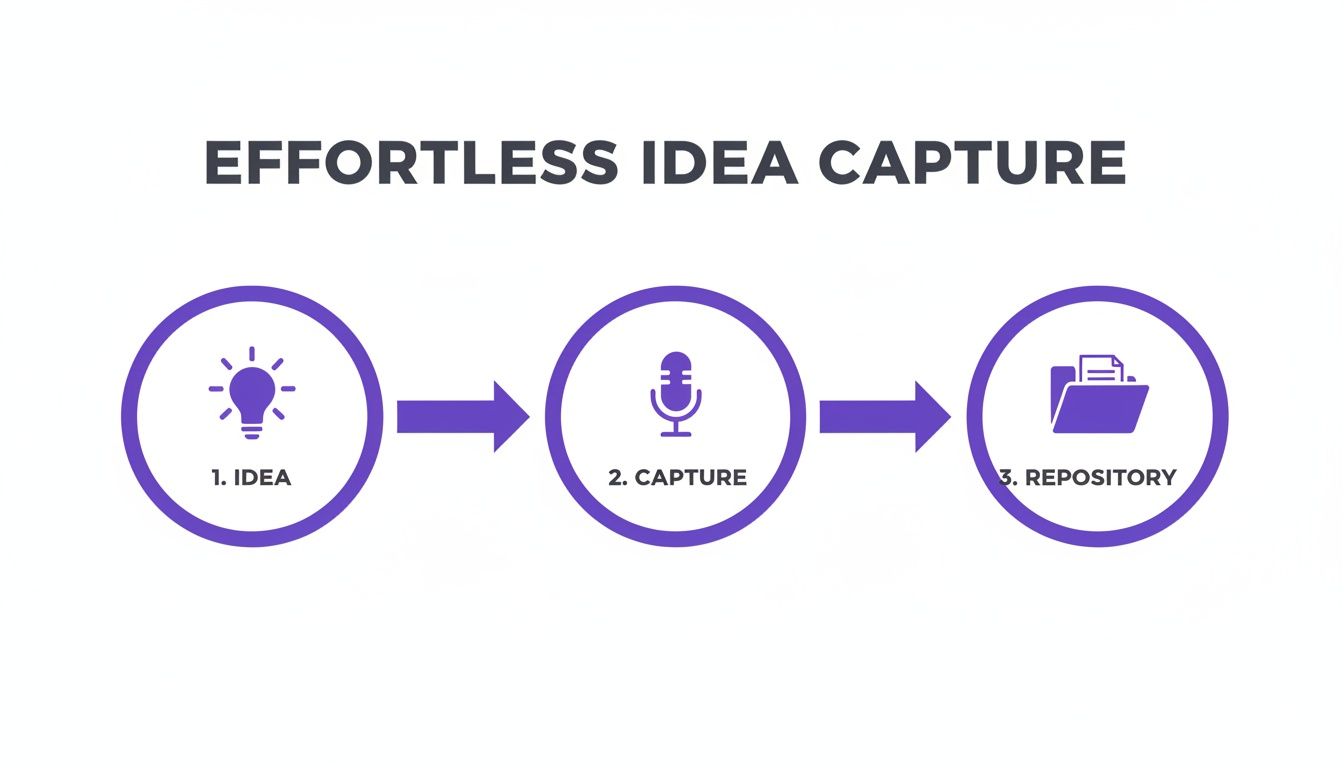
This little system ensures no good thought gets left behind. It's about building a reliable content engine, not waiting for inspiration to strike.
The Three-Column Workflow: Notes to Draft to Preview
Picture a simple editor split into three columns. This mental model is my secret weapon for refining thoughts without getting overwhelmed. It’s a core concept in any good social media guide because it forces you to separate the stages of creation, which is critical.
- The Notes Column: This is where your raw, transcribed voice notes land. It's messy, full of "ums" and "ahs," and that’s perfectly fine. The goal here isn't to edit; it's just to dump all the raw material in one place.
- The Draft Column: Now the fun begins. Here, you (or an AI assistant like PostFlow's Emilia) start to find the signal in the noise. You pull out the strongest points from your notes, arrange them into a story that makes sense, and hammer out a first draft. This is also where you decide if it’s a text post, a carousel, or maybe a script for a quick video.
- The Preview Column: This is your final quality check. The preview column shows you exactly what your post will look like on LinkedIn. It’s a lifesaver for catching weird line breaks or realizing your killer hook is buried three lines down.
This approach keeps you from falling into the classic trap of trying to write and edit at the same time—a habit that kills creativity and momentum faster than anything else. If you want to dive deeper into the nuts and bolts of writing, check out our guide on how to write impactful LinkedIn posts.
Define Your Vibe Before You Draft a Single Word
Hold on. Before you start writing, you need to define your "vibe." This is just a simple way of thinking about your tone, your audience, and what you’re trying to achieve. Without this, even the smartest AI assistant is going to churn out generic, soulless content.
Think of your vibe as a mini-brief for every post. Are you trying to be:
- The Authority? Sharing deep, educational insights for your peers.
- The Relatable Founder? Telling personal stories for others on the same journey.
- The Provocateur? Posing tough questions to get a real conversation started.
Setting your vibe is what makes AI-assisted content sound like you. It’s the difference between using a tool to amplify your voice and letting it completely take over.
From Voice Memo to Carousel: A Real-World Example
Let’s make this concrete. Say you're a consultant who just wrapped up a great project. You grab your phone and record a quick two-minute voice memo: "Client was struggling with low team morale... so we ran our workshop framework... saw a huge jump in their internal survey scores... the main thing was getting managers to actually listen... really proud of this win."
Here’s how that messy thought becomes a polished post using the three-column workflow:
- Notes: You've got the full, unfiltered transcription of your voice memo.
- Draft: An AI tool can help you structure this into a compelling story, maybe suggesting a 5-slide carousel.
- Slide 1 (Hook): "Team morale was in the basement. Here's the simple shift that changed everything."
- Slide 2 (Problem): "Managers were talking, but nobody was listening. Sound familiar?"
- Slide 3 (Solution): "We introduced one rule: Ask, don't just tell."
- Slide 4 (Result): "The outcome? A 40% jump in employee engagement scores in just 60 days."
- Slide 5 (CTA): "What's the #1 morale killer you've seen? Drop it in the comments."
- Preview: You see the carousel exactly as it will appear, making sure each slide is punchy and easy to digest.
This is how you turn a simple reflection into a powerful piece of content that proves you know your stuff. This kind of consistency is everything. The data shows that only those posting 3-5 times weekly see real, sustained growth, and aiming for just 3 posts a week can boost your impressions by up to 40%. It's all about having a system that lets you hit that cadence without burning out.
Scheduling Content For Maximum Reach And Impact

You've done the heavy lifting—capturing your raw ideas and polishing them into great posts. Now for the final piece of the puzzle: getting that content in front of the right eyeballs at the right time.
Posting whenever you feel like it is like throwing a party but only sending out invites after it's already over. You're just torpedoing your own hard work.
Strategic scheduling is what turns a decent post into one that actually gets seen and drives engagement. It’s the difference between your content fizzling out quietly and sparking a real conversation.
Beyond The Generic Best Time To Post
We've all seen those infographics screaming that Tuesday at 10 AM is the magical hour to post. While they might give you a vague starting point, they're mostly useless. Why? Because they're based on massive, generic data pools, not your audience.
The best time for you to post depends entirely on the habits of your followers. Are they East Coast execs scrolling LinkedIn over their morning coffee, or West Coast founders who are most active after lunch? A generic chart can't tell you that.
The only scheduling strategy that truly works is one built on your own data. Smart tools can analyze when your followers have historically engaged with your content most, giving you personalized time slots that actually make sense.
This data-first approach takes all the guesswork out of the equation. You stop posting and praying, and start publishing with the confidence that you’re meeting your audience right where they are.
Finding Your Ideal Posting Cadence
Let me be clear: consistency beats frequency every single time. The goal isn't to blast your network with content until they unfollow you. It's about finding a sustainable rhythm that you can maintain and that your audience can come to expect.
Your ideal cadence really comes down to your role and what you’re trying to achieve:
- For a Startup Founder: Posting daily (or close to it) often makes sense. You're building a brand from zero, sharing the journey, and your audience is there for the high-volume, behind-the-scenes look.
- For a B2B Consultant: Three high-quality, deep-dive posts a week might be the sweet spot. Each piece is designed to establish authority and requires more from both you and your readers.
- For an Agency Owner: A balanced mix of case studies, team wins, and industry hot takes spread across four posts a week could be perfect. This approach showcases results, culture, and expertise without feeling repetitive.
The trick is to pick a cadence you can actually stick with long-term. Laying out your posts on a calendar helps you see this rhythm visually, ensuring you don't burn out or post the same type of content over and over. If you want to dive deeper into the nuts and bolts, our guide on how to schedule social media posts is a great next step.
Using A Content Calendar To Stay Balanced
A content calendar isn't just a scheduling grid; it's your strategic command center. It's what allows you to plan ahead and make sure your feed tells a coherent story, rather than feeling like a random stream of thoughts.
By mapping things out, you can deliberately mix up your formats and topics to keep things fresh. It stops you from accidentally posting three carousels in a row or only talking about one subject for a whole week. A well-managed calendar ensures you’re hitting your key messaging pillars consistently, building a much more interesting and valuable feed for your followers.
How To Measure What Actually Matters On LinkedIn
You've planned, recorded, and scheduled your content. Awesome. But that’s only half the job done. The final piece of the puzzle—and honestly, the most critical one—is figuring out what’s actually working. Without that feedback loop, you’re just throwing content at the wall and hoping something sticks.
Likes and views feel great, I get it. But they're often just vanity metrics. They won’t tell you if your content is actually building your authority, bringing in leads, or sparking conversations that matter to your bottom line. To get smarter with your next batch of posts, you have to dig deeper than the surface-level numbers.
Moving Beyond Vanity Metrics
The whole point of checking your LinkedIn performance isn't just to see which post got the most likes. It’s about understanding the why behind the numbers. This is where you shift your focus to metrics that give you real, actionable insights into your audience and content strategy.
Instead of getting lost in a sea of data points, just concentrate on a few key indicators that tell a much bigger story.
- Impressions for Reach: This number simply tells you how many times your post was shown in someone's feed. While a big number is nice, its real value is in showing you which topics have the broadest appeal, getting your name in front of more eyeballs.
- Engagement Rate for Resonance: Now this is a far better measure of quality than raw likes. A high engagement rate (comments, shares, and likes divided by impressions) means your post didn't just fly by—it made someone stop, think, and interact.
- Profile Views for Genuine Interest: This is a seriously powerful, and often overlooked, metric. When someone sees your post and is curious enough to click through to your profile, that’s a huge signal of genuine interest. They want to know more about you.
Honing in on these three core metrics helps you start connecting your content efforts to real business outcomes.
The best insights come from asking the right questions. Don't just ask, "How many likes did this get?" Ask, "Which post started the most meaningful conversations in the comments?" That second question is what leads to a better content strategy.
Answering The Big Questions With Your Data
Think of your analytics dashboard less like a report card and more like a roadmap. It’s there to help you answer the big questions that will shape everything you create next. The answers you find will tell you what to double down on and what to ditch.
You should be able to answer these questions by looking at your data from the last 30 to 90 days:
- What topics generate the most meaningful conversations? Scan for posts with the highest number of comments, not just likes. Are they personal stories, controversial takes on your industry, or super-practical tips? This tells you what truly connects with your audience on a deeper level.
- Which formats does my audience prefer? Put your text-only posts, carousels, and videos head-to-head. Maybe you’ll find your audience devours the detailed breakdowns in your carousels but barely touches your videos. That insight alone can save you hours of wasted effort. To get a better handle on audience interaction, it's worth exploring how AI measures social media engagement and folding those ideas into your LinkedIn approach.
A Real-World Scenario In Action
Let's say you're an agency owner who has been mixing it up with different content types: quick tips as text posts, behind-the-scenes team photos, and client case studies as carousels. After a month, you sit down to look at the numbers.
You spot something interesting. The team photos get a decent amount of likes, but the client case study carousels have the highest engagement rate by far. Not only that, but they’re also driving a clear spike in profile views on the days they’re posted. The real kicker? You realize two of your three inbound leads that month came within 48 hours of posting a case study.
The data is practically screaming at you. While the other content is perfectly fine, the case study carousels are what’s actually moving the needle for your business. That's the power of measuring what matters. It gives you an undeniable, data-backed reason to create more of what works. For a more detailed breakdown, our guide on how to measure social media success offers even more practical steps.
Got Questions? I've Got Answers
Even with the best workflow in place, a few questions always seem to pop up once you start putting a new system into practice. I've been there. Let's tackle some of the most common ones I hear so you can move forward with confidence.
How Often Should I Really Be Posting On LinkedIn?
For real, sustained growth, the magic number seems to be 3 to 5 high-quality posts per week. Anything less than that, and you'll struggle to gain any traction with the algorithm.
Posting more often—say, every single day—can actually work against you by fatiguing your audience, unless every post is an absolute banger. It's a tough standard to maintain.
At the end of the day, quality will always, always beat quantity. One truly insightful post is worth more than three mediocre ones. Find a consistent rhythm that you can actually stick to without burning out. That's the real key.
What Content Formats Are Actually Working Right Now?
Right now, carousel posts are crushing it. They're basically just multi-image slideshows saved as a PDF, but they are fantastic for telling a story or breaking down a complex idea into easy-to-digest steps. The engagement on these can be massive.
Native video, especially short clips under 90 seconds, is also a powerhouse for building a more personal connection. But don't sleep on a well-written, text-only post. Sometimes, they spark the deepest, most meaningful conversations in the comments.
The smartest play? Mix it up. Use a variety of formats and then—this is the important part—check your own analytics. Your data will tell you exactly what your audience wants to see. Listen to it.
How Can I Use AI Without Sounding Like A Soulless Robot?
This is a big one. The trick is to treat AI as your assistant, not your ghostwriter. The process has to start with your authentic ideas, in your own words. AI's job is to help you structure and polish those thoughts, not invent them from scratch.
Here’s how you keep it human:
- Start with your voice. Always. Begin with a raw voice note or a quick, messy brain dump. This anchors the entire post in your unique perspective from the very beginning.
- Give it clear instructions. Before you ask it to write anything, tell the AI about your personal tone and style. Think of it as giving your assistant a brand guide.
- Edit ruthlessly. This is non-negotiable. Read every single draft out loud. Does it sound like you? Would you say that phrase in a real conversation? If not, change it. Add your own stories, quirks, and personal examples.
Think of it this way: AI handles the grunt work of formatting and structuring, which frees you up to focus on the one thing it can't do—sharing your genuine message.
What's The Easiest Way To Come Up With New Post Ideas?
Stop trying to "brainstorm." Seriously. That scheduled block on your calendar to "think of ideas" is a recipe for staring at a blank screen.
The easiest, most sustainable way to generate content is to simply document your day-to-day work and thinking. Build a simple habit of capturing ideas the second they pop into your head.
Just finished a great client call? Learned something new from a teammate? Had a strong opinion about an article you just read? Grab your phone, open the voice recorder, and just talk for 60 seconds. Rant a little. Explain your takeaway.
Doing this consistently creates an incredible library of raw, authentic content ideas rooted in your actual expertise. The pressure vanishes. You already have the ideas—you just need a better system for catching them before they disappear.
Ready to stop missing opportunities on LinkedIn? PostFlow gives you the system to turn your expertise into consistent, high-impact content that grows your business. Try PostFlow today and meet Emilia, your AI content strategist.