
So, what exactly is social media content planning? Think of it as the roadmap for your online presence. It’s the difference between throwing spaghetti at the wall to see what sticks and deliberately building something that achieves real business goals—like establishing your authority and bringing in leads.
Why Your Current Social Media “Strategy” Is Failing
Does this sound familiar? You feel the constant pressure to post, you’re putting content out there, but you’re just not seeing the results. It's a frustrating place to be, and it’s a classic symptom of the "post when you feel inspired" approach.
That method almost always leads to two things: burnout and a scattered online presence that never gains any real traction. It's the #1 reason why most social media efforts fall flat.
When you don't have a plan, every single day kicks off with that same nagging question: "What am I going to post today?" This pressure cooker environment forces you to pump out generic content just to fill the silence. The result? A disjointed brand message and missed opportunities to connect with the very clients you want to attract.
For most founders and consultants, this is what a chaotic, unplanned social media feed feels like.

This image nails that feeling of being completely overwhelmed by the never-ending demands of social media. This cycle of stress and inconsistent results isn't just unsustainable; it’s a dead end for business growth.
The True Cost of Inconsistency
Here’s the thing: the problem isn't usually a lack of ideas. It's the lack of a system. Without a workflow, you're stuck in a reactive loop, creating content that serves the immediate need to post rather than a long-term vision. This is what stops you from building the kind of trust and authority that converts followers into paying clients.
On a platform like LinkedIn, consistency is everything. The numbers don't lie: professionals who post weekly get 5.6 times more followers and grow seven times faster than those who only post monthly. With over 9 billion impressions hitting the feed every single week, a solid social media content planning framework is the only way to make sure your voice isn't drowned out. If you need more convincing, check out these LinkedIn marketing statistics that prove why showing up consistently matters.
The goal isn't just to be present on social media; it's to be purposeful. A strategic plan ensures every piece of content you share is a deliberate step toward building your brand and achieving your business objectives.
This is exactly where having a dedicated framework, especially one powered by modern AI tools like PostFlow, changes the game. It takes your efforts from chaotic to controlled, turning scattered posts into a powerful, reputation-building machine.
This guide will give you that exact framework.
Know Your Audience and Define Your Goals
Before you even think about writing a post, we need to get two things straight: Who are you really talking to, and what's the point of it all? Nail these, and your content goes from shouting into the void to starting valuable conversations. Skip this step, and you’re just making noise.
This is the foundational work that separates content that gets a few polite likes from content that actually starts a DM with a potential client.
Go Deeper Than "Other Professionals"
"My audience is other professionals." I hear this all the time, and frankly, it’s not nearly enough. To make a real connection, you have to get inside their world. Let's move past vague labels and build a persona for someone you can actually help.
Think about a B2B consultant who wants to work with VPs of Operations at enterprise companies.
- What keeps them up at night? They aren't stressed about minor workflow tweaks. They're losing sleep over major supply chain breakdowns, ballooning operational costs, and the relentless pressure to boost team productivity by 15% this quarter.
- How do they talk? They use specific language. It’s all "optimizing workflows," "slashing OpEx," and "driving scalable growth." If your content just says "making things better," you've already lost their respect. You have to speak their language to earn their trust.
- What are their career ambitions? That VP of Ops wants to be the innovator who delivers real, measurable results. They're gunning for a spot in the C-suite. Your content needs to be the secret weapon that helps them get there.
When you get this specific, you can create content that hits them right where they are, making them feel like you truly get it.
Tie Your Social Media Goals to Real Business
Okay, so you know who you’re talking to. Now, what do you want them to do? Goals like "increase engagement" are vanity metrics unless they lead to something tangible. Your social media goals have to act as a bridge between your content and your bank account.
A real goal isn't just a number; it’s a business outcome. A great way to frame this is by thinking through a complete inbound lead generation playbook, which helps connect your daily posts to the bigger picture of generating revenue.
Let's be clear: the goal of your professional social media isn't to rack up followers. It's to build a pipeline. Every single post should be an asset that builds trust, showcases your expertise, and gently guides the right people toward hiring you.
Let’s look at how this plays out in the real world.
| Professional Profile | Vague Goal | Meaningful Business-Oriented Goal |
|---|---|---|
| Startup Founder | "Get more visibility" | "Secure 3-5 intro calls with potential investors per month by showcasing traction and thought leadership on LinkedIn." |
| B2B Sales Consultant | "Increase engagement" | "Generate 10 qualified leads per quarter by sharing case studies and insights that drive demo requests through LinkedIn." |
See the difference? The second column is full of specific, measurable goals tied directly to growing a business. This gives you a crystal-clear "why" for every post you create. This kind of strategic focus is the bedrock of solid social media content planning and ensures the time you spend on platforms like LinkedIn actually pays off.
Develop Your Core Content Pillars and Idea Capture System

Alright, you know who you're talking to and what you want to achieve. Now it's time to build the engine of your content machine. This is where we shift from high-level strategy to a practical plan that ensures you never stare at a blank screen wondering what to post again.
The secret is to stop thinking in terms of one-off posts and start thinking in themes. This is the heart of social media content planning—creating a system that makes your content creation predictable and, most importantly, sustainable.
Establish Your Content Pillars
Think of content pillars as the 3-5 core themes you want to own in your space. These are the big-picture topics that consistently showcase your expertise and speak directly to the problems your audience is trying to solve. They’re the guardrails that keep every post you create relevant and on-brand.
Let’s imagine a B2B sales coach. Their pillars might look something like this:
- Prospecting Strategies: Covering everything from cold outreach to getting warm intros.
- Objection Handling: Sharing real-world frameworks for turning a "no" into a real conversation.
- Closing Techniques: Focusing on the critical final steps to get a deal signed.
- Sales Mindset & Productivity: Tackling the mental game and organizational habits behind top performance.
With pillars like these, the question is no longer, "What should I post today?" Instead, it becomes, "Which pillar am I going to riff on today?" This simple shift brings focus and variety to your content.
Break Pillars Down into Actionable Ideas
Once you have your pillars, the real magic begins. You can break each one down into an almost endless stream of specific post ideas. Every pillar can branch out into dozens of subtopics, personal stories, and unique angles.
This table shows exactly how our sales coach could turn the "Objection Handling" pillar into four distinct pieces of content.
Content Pillar Breakdown Example for a B2B Sales Coach
| Content Pillar | Subtopic | Post Idea/Angle | Potential Format |
|---|---|---|---|
| Objection Handling | Price Objections | A personal story about losing a deal on price and the hard lesson learned. | Text-only post |
| Objection Handling | "I need to think about it" | A 3-step script for responding without sounding pushy or desperate. | Carousel/Slider |
| Objection Handling | Gatekeeper Resistance | Quick tip on how to build rapport with an executive assistant. | Short text post |
| Objection Handling | Competitor Comparisons | An analysis of when to bring up a competitor vs. when to ignore them. | LinkedIn Article |
See how that works? One high-level theme just spawned four ready-to-go content ideas. If you do this for each of your pillars, you'll have a backlog of content to pull from for weeks, if not months. If you're still feeling stuck, our guide on finding great social media content ideas can help get the wheels turning.
Create a Bulletproof Idea Capture System
Inspiration is fickle. Your best ideas almost never arrive when you're sitting at your desk. A founder has a breakthrough thought about their market while on a run. A consultant cracks a client's problem during their commute. Without a system to catch these thoughts, they vanish.
The goal isn't to have more ideas; it's to lose fewer of them. A reliable capture system is the bridge between a fleeting thought and a high-impact LinkedIn post.
This system doesn't need to be fancy. In fact, simpler is usually better. The best tool is the one you always have on you: your phone.
Using a voice notes app is a total game-changer. Just open it, record your raw thought, and get back to your day. It’s frictionless.
This is especially powerful when you pair it with AI-assisted tools like PostFlow. You can record a messy, unedited voice note about a new industry trend, and the AI can transcribe it, pull out the core message, and draft a polished LinkedIn post from it. That workflow turns a 30-second moment of insight into a nearly finished piece of content.
This systematic approach is what makes consistent posting possible, even for the busiest professionals out there. And in a space like LinkedIn, which sees a mind-boggling 9 billion content impressions every week, consistency is everything. The data doesn't lie: professionals who post weekly see 5.6 times more follower growth than those who only post monthly. A structured plan isn't a nice-to-have; it's essential for getting seen.
Build an Efficient Content Calendar and Workflow

Great ideas are just the starting line. To actually turn them into consistent content that builds your brand, you need a system. This is where a solid content calendar and a smart workflow come in, shifting your social media from a reactive chore to a proactive strategy.
Think of a content calendar as your single source of truth. It’s a visual map of what you’re posting, where you're posting it, and when. This simple tool is what gets you out of the daily scramble for ideas and gives you a clear, big-picture view of your content for the weeks or even months ahead.
And no, it doesn't have to be complicated. You can kick things off with a simple spreadsheet or a dedicated tool. The medium matters far less than your commitment to actually using it.
Setting Up Your First Content Calendar
The main goal here is to organize the ideas from your content pillars into a logical sequence. It helps you maintain a balanced mix of topics and formats, stopping you from accidentally posting about the same subject five times in a row.
Start by mapping out a basic structure. At a minimum, your calendar should track these key elements:
- Publish Date: The exact day and time the post goes live.
- Platform: Which social network is this for? (e.g., LinkedIn).
- Content Pillar: The core theme this post connects back to.
- Post Copy: The final, polished text for your post.
- Visual Asset: A link to the image, video, or graphic you'll use.
- Status: A simple tracker to know where things stand (e.g., Idea, Draft, Scheduled, Published).
Building an efficient calendar is fundamental for consistent posting. If you need a jumping-off point, a good YouTube content calendar template can offer a structured approach that you can easily adapt for any platform.
The Power of Content Batching
A calendar is only as good as the workflow that feeds it. This is where content batching becomes a total game-changer, especially for busy professionals. Instead of trying to create and post something new every single day, you dedicate a specific block of time to knock out an entire week’s or month’s worth of content at once.
This approach is incredibly efficient. It lets you get into a creative flow state without the constant context-switching that comes with daily posting.
Batching isn’t about creating lower-quality content faster. It’s about creating a dedicated space for deep, focused work that results in higher-quality content and saves you a ton of time.
For an agency owner trying to reach the C-suite—where 50% of executives engage with content for at least an hour a week—random, ad-hoc posting just won’t cut it. To grab their attention, you have to deliver high-value insights consistently. Globally, LinkedIn is the undisputed king for B2B, with 90% of decision-makers valuing thought leadership. A planned, batched workflow ensures your expert content actually reaches this critical audience.
A Real-World Batching Workflow
Let's walk through a real scenario. Imagine a consultant who wants to plan and schedule an entire month of high-quality LinkedIn content. Here’s how they could get it all done in a single afternoon:
Hour 1 (Ideation & Outlining): Pull up your content pillars and the ideas you’ve already captured. Pick out 12 post ideas for the month (that’s three posts per week) and jot down a quick, one-sentence outline for each right inside your content calendar.
Hour 2 (Drafting): With your outlines ready, it's time to write. Focus only on drafting the copy for all 12 posts. Don't get hung up on perfection; just get the core messages down on paper.
Hour 3 (Refining & Visuals): Now, circle back and edit each draft. Polish the text for clarity, tone, and impact. As you edit, identify or create the visual assets you'll need for each post.
Hour 4 (Scheduling): The final step. Take your finished copy and visuals and load them into your scheduling tool of choice. Set the publish dates and times for the entire month, and you're done.
By dedicating just a few focused hours, you’ve completely eliminated the daily pressure of content creation. It’s a repeatable system that not only reclaims your time but also ensures your brand voice stays consistent and professional. For more tips on this, check out our guide on creating a social media content calendar.
Amplify Your Content Through Repurposing and Analytics
Hitting “publish” on a piece of content isn’t the finish line—it’s the starting gun. A truly effective social media content planning process doesn’t stop once a post is scheduled. The real magic happens when you wring every last drop of value from your hard work through smart repurposing and sharp performance analysis.
This one-two punch ensures your best ideas reach the widest possible audience while giving you the data to make your next round of content even stronger. It's a powerful feedback loop that separates stagnant social media feeds from those that consistently build authority and drive real growth.
Think of it as a cycle, not a straight line.
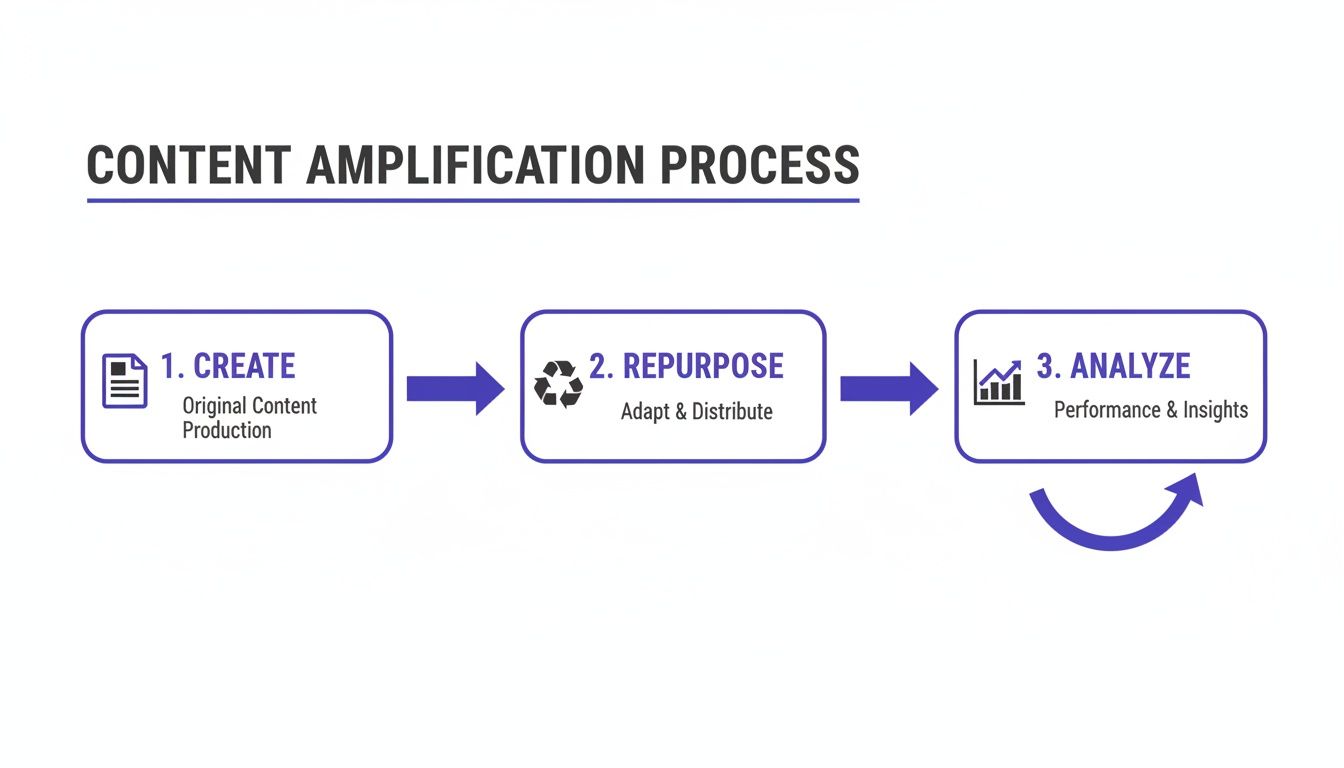
This simple workflow is the key to sustainability: create once, repurpose to multiply your reach, and analyze to get smarter for next time.
Multiply Your Output with Content Repurposing
Why spend hours crafting one brilliant idea for a single post when that same idea could fuel your content for an entire week? Repurposing is the art of working smarter, not harder. You take one core concept and translate it into multiple formats, adapting it for different platforms and how people consume content there.
Let's say you have a fantastic client success story. Instead of a one-and-done text post, you could amplify it like this:
- The Original Post: A detailed text post on LinkedIn breaking down the client's problem, your solution, and the impressive results.
- The Carousel: Turn the key steps of your solution into a visually engaging carousel with bold text and simple graphics. Much more skimmable.
- The Short Video Script: Record a quick 60-second video sharing the single most impactful takeaway from the project. Perfect for grabbing attention.
- The Quote Graphic: Pull a powerful testimonial from the client and design it into a clean, shareable image.
Just like that, one core idea becomes four distinct pieces of content. This strategy helps you maintain a consistent presence without the constant pressure of brainstorming brand-new topics from scratch. For a deeper dive, our guide on content repurposing strategies has even more ideas.
Track What Truly Matters
Analytics can feel like a data firehose, but you don’t need to track every single number. The key is to focus only on the metrics that tie directly back to the business goals you set earlier. A vanity metric might feel good, but an actionable metric helps you make better decisions.
Don’t get lost in a sea of data. Your goal isn't just to measure performance; it's to gain insights that make your content more effective over time. Focus on 2-3 key metrics that tell you if you're on the right track.
For example, if your primary goal is building an engaged community, your most important metrics are comments and shares. These prove your content is sparking conversation and resonating enough for people to pass it along.
But if your goal is lead generation, then the click-through rate (CTR) on links to your website or landing pages is what really matters. It's the clearest sign that your content is successfully moving people from awareness to action.
Let Data Drive Your Content Decisions
Your analytics are a direct line of communication from your audience. They’re telling you exactly what they find valuable, interesting, and worth their time. You just have to listen.
If you notice that posts featuring personal stories consistently get more comments, that's a signal to weave more narrative into your content. If carousels explaining a process have the highest share count, it's time to make them a regular part of your content mix.
This is especially critical when you're deciding between formats. Video content on LinkedIn, for instance, is absolutely booming—uploads have surged 44% year-over-year. Why should you care? Because videos get five times more engagement than standard text posts, and posts with images see double the comment rate. These aren't just fun facts; they are strategic directives for your content calendar.
By regularly reviewing what works and what doesn’t, you can stop guessing and start making informed decisions. This data-driven approach allows you to systematically refine your social media content planning, ensuring each new piece of content has a better chance of success than the last.
Your 30-Day Action Plan for Consistent Content
Alright, theory is great, but execution is what actually builds a brand. This entire guide boils down to one powerful idea: a solid content plan creates a sustainable system, not just another daily chore you have to worry about.
Let's distill everything we've covered into a clear, 30-day roadmap to get you moving immediately. This isn’t about chasing trends; it's about building a disciplined process that turns your expertise into a real growth engine for your business.
Week 1: Laying the Foundation
The first week is all about getting your strategy straight. Seriously, don't even think about writing a single post until you have a clear direction. Doing this foundational work ensures every piece of content has a purpose and actually moves you closer to your goals.
Days 1-2: Audience & Goals: Get super specific. Who are you really talking to? What are their biggest headaches and challenges? Then, set 1-2 tangible business goals for your social media. Something concrete, like "generate five qualified leads this quarter."
Days 3-4: Content Pillars: Time to brainstorm your 3-5 core themes. What are the key areas of your expertise that your ideal audience desperately needs help with? Write them down and stick to them.
Days 5-7: Idea Capture: Now, set up your system. It could be a voice notes app, a messy Google Doc, whatever works for you. The key is to start capturing every relevant thought, question, or story that pops into your head related to your pillars. Aim to bank at least 15-20 raw ideas this week.
Week 2: Build Your Workflow
With a bank of ideas ready to go, it's time to build your content machine. This week is all about turning those raw concepts into polished content and getting organized for the month ahead.
The goal here is to transform content creation from a daily pressure-cooker into a focused, scheduled task. A repeatable workflow is the secret to long-term consistency and high-quality output.
Block out a solid two-hour chunk of time to batch-create your first two weeks of content. Sticking to your pillars, draft 6-8 posts. Don't chase perfection—just get the core message down. Once they're drafted, load them into your content calendar or a tool like PostFlow and get them scheduled.
Weeks 3 & 4: Analyze, Learn, and Refine
Your content engine is now running. The final phase is all about learning and getting better.
As your scheduled posts go live, start paying close attention to your analytics. Which posts sparked the most comments? Which ones actually drove clicks to your website?
Use these insights to inform your next content batching session. Double down on what clearly resonates with your audience. Don't be afraid to experiment with a new format, like turning a top-performing post into a carousel or a short video script. This is the feedback loop that will sharpen your strategy over time and make your content truly effective.
Have Questions? Let's Get Them Answered
Even with the best game plan, a few questions always pop up. I get it. I’ve helped countless founders and consultants navigate these exact same hurdles. Here are the most common ones I hear, along with some straight-up advice to keep you moving.
"Seriously, How Often Should I Be Posting on LinkedIn?"
This one comes up all the time. The answer isn't about spamming your network—it's about smart consistency. The sweet spot for most professionals on LinkedIn is 3-5 high-quality posts a week.
This isn't just a random number. We know that posting weekly can boost your follower growth by more than 5x compared to just posting once a month. But here's the real talk: it’s far better to publish three fantastic, thoughtful posts every single week like clockwork than to go hard with daily posts for a week and then disappear for a month. That's where a good scheduling tool becomes non-negotiable for maintaining a steady rhythm.
"How Can AI Tools Actually Help Me Plan Content?"
Think of a good AI tool as your strategic sidekick, not just an order-taker that writes posts. Its real magic is in breaking through creative logjams and taking the grunt work off your plate. Imagine turning a quick voice note about a client win into three completely different post ideas—that's the power we're talking about.
An effective AI assistant doesn't replace your expertise; it amplifies it. It handles the tactical heavy lifting—like drafting, formatting, and scheduling—so you can focus on the unique insights that only you can provide.
A great AI-powered tool won't just spit out generic text. It will ask you smart follow-up questions to help you dig deeper into your own ideas. From there, it can whip up a few drafts, suggest the best times to post, and even help you track what’s working later on. This frees you up to think about the big picture and what you really want to say.
"What Happens When I Run Out of Ideas?"
This is a huge fear, but a solid system makes it a non-issue. Your content pillars are your secret weapon here. The next time you feel stuck, don't just stare at a blank cursor. Go back to your pillars and their subtopics.
Ask yourself a few simple questions:
- What's a question I've heard from three different clients this month?
- What’s a recent industry trend that everyone is getting wrong?
- Is there a personal story I can share that brings one of my core principles to life?
Your idea-capture system is your safety net. Make it a habit to drop voice notes into your phone whenever an idea hits you—in the car, on a walk, wherever. A tool that can transcribe those thoughts and help you shape them into real content means you’ll never be running on empty again. You'll have a backlog of authentic, valuable ideas ready to go.
Ready to stop guessing and start building a powerful, consistent presence on LinkedIn? PostFlow is the AI content strategist that helps you turn those fleeting thoughts into compelling posts that build your authority and your business. It's time to end the daily content scramble for good.
See how PostFlow can streamline your content planning today.