We’ve all been there. Staring at that blank LinkedIn post editor, the cursor blinking, feeling like you're about to take a test you didn't study for. A social media content calendar is what turns that daily anxiety into a real strategic advantage. It shifts you from posting random updates whenever you remember to building a deliberate system for growth.
Frankly, it's the difference between occasionally shouting into the void and consistently building a professional brand people actually listen to and trust.
Why a Content Calendar Is Your Secret Weapon on LinkedIn
This isn't about just creating more content. It's about deploying smarter content that directly ties back to your business goals. Think of your calendar as the engine that powers your authority and visibility on the platform.
A well-planned calendar turns your expertise into a reliable, value-packed presence that your network can count on. Whether you're a B2B consultant trying to land clients or a startup founder building a movement, this structured approach signals reliability to both the LinkedIn algorithm and your ideal customers.

From Chaos to Cohesion
Without a plan, social media often feels like a reactive scramble. You post when inspiration strikes—maybe three times one week and not at all the next. That kind of inconsistency just confuses your audience and makes it impossible to build any real momentum.
A content calendar brings structure and intentionality to the table. It hands you a few key advantages that directly impact your growth:
- Strategic Alignment: Every single post has a purpose. It ties back to your bigger business objectives, whether that's generating leads, boosting brand awareness, or establishing yourself as a thought leader.
- Time Efficiency: You can batch your content creation. By dedicating specific blocks of time to plan and write posts, you free up a ton of mental energy and ditch the daily pressure of "what do I post today?"
- Improved Content Quality: When you aren't rushing to meet a self-imposed daily deadline, you have the space to create more thoughtful, well-researched, and genuinely engaging posts that connect with your network.
Consistency Signals Credibility
On LinkedIn, consistency is currency. It’s that simple. Posting regularly shows you're committed and know your stuff, which builds trust with your followers over time. A strategic LinkedIn content calendar is crucial, not just for organizing posts, but for delivering the kind of consistent value that helps you build a powerful personal brand and opens up new opportunities.
A calendar is your accountability partner. It makes sure you show up for your audience regularly, turning passive connections into an engaged community that actually looks forward to what you have to say.
The data backs this up, too. LinkedIn pages that post weekly see 5.6 times more follower growth than those that post only now and then. This stat just hammers home a timeless truth: consistency is the secret sauce.
Ultimately, a social media content calendar gets rid of the guesswork. It replaces it with a clear, actionable roadmap to get where you want to go.
Laying the Groundwork for Your Content Strategy
Before you even think about dropping a single post into your content calendar, we need to talk about your destination. If you don't know where you're going, any road will get you there—and on LinkedIn, that means getting lost in the noise.
Every single piece of content you create must be a deliberate move toward a specific business goal. Without that clarity, you're just posting for the sake of posting.
So, let's start with the most important question: what is the real purpose of your LinkedIn presence? Are you trying to book more sales calls for your consulting gig? Is your main goal to build such strong brand recognition that you're the first name people think of in your industry? Or are you playing the long game to become the undisputed expert in your niche?
Your "why" is the filter. It’s the gatekeeper that decides which content ideas make the cut and which ones get tossed.
Nail Down Your Primary Objective
Vague ambitions like "growing my audience" are a recipe for mediocre content. You need a sharp, measurable objective, because the content you create for lead gen looks completely different from the content you'd create for brand awareness.
Let’s break down the most common goals I see on LinkedIn:
- Lead Generation: This is all about driving action. Your posts are designed to get someone to book a demo, download a whitepaper, or schedule a call. The content zeroes in on client pain points and positions your service as the undeniable solution.
- Brand Awareness: Here, the name of the game is reach and visibility. You’re sharing industry news, telling stories about your company culture, or asking broad, engaging questions to spark conversations and get your brand in front of as many eyes as possible.
- Thought Leadership: The goal is to become a trusted, authoritative voice. This means sharing deep, original insights, challenging conventional wisdom, and offering analysis that genuinely educates your audience.
Pick one primary goal to start. I've seen too many people try to do all three at once, and it just dilutes their message and confuses everyone. Once you’ve gained momentum, you can layer in a secondary objective, but for now, focus is everything.
Get Clear on Who You're Talking To
Okay, you’ve got your goal. Now, who are you actually trying to reach? It’s not enough to know their job title. You need to get inside their head.
What are the problems that keep your ideal customer up at night? What are their biggest professional frustrations? What kind of post would make them stop their frantic scroll and think, "Finally, someone who actually gets it"?
This is where a detailed audience persona becomes non-negotiable. Don't just target "startup founders." Get specific. Think about "Sarah, the founder of a 10-person tech startup who is completely overwhelmed by marketing and isn't seeing any ROI."
That level of detail is what transforms generic content into something that feels personal and urgent. When you're brainstorming for your content calendar, you can ask a simple question: "Would Sarah find this helpful?" This simple check is your secret weapon for keeping your content relevant. It's also what helps AI tools like PostFlow generate content that actually connects with real people.
Choosing Your Core Content Pillars and Formats
You’ve figured out your goals and who you're talking to. Awesome. Now comes the fun part: deciding what you’re actually going to talk about. This is where you move from abstract strategy to building a real personality for your brand on LinkedIn.
We do this by establishing your core content pillars.
Think of content pillars as the 3-5 foundational topics you’ll own. These aren't just random subjects; they're the core themes that everything you post will tie back to. They’re the channels of your personal broadcast station, ensuring every piece of content reinforces your expertise and actually helps your audience.
For example, a financial advisor I know doesn't just post about "money." Their pillars are specific: 'Retirement Planning,' 'Investment Myths,' and 'Wealth Management for Entrepreneurs.' Every post, video, or carousel fits neatly into one of those buckets, constantly reminding their network what they're the best at.
Identifying Your Foundational Topics
Your pillars need to live at the sweet spot where your deep expertise meets your audience's biggest headaches. They have to be broad enough that you'll never run out of ideas, but specific enough that you become the go-to person for that topic.
Struggling to nail them down? Grab a notebook and jot down the answers to these questions:
- What are the top 5 questions your clients ask you over and over again?
- What’s a common industry myth you’re tired of hearing that you can debunk?
- What unique perspective or hard-won experience do you have that nobody else does?
- Honestly, what topics could you talk about all day without getting bored?
The patterns in your answers are your future content pillars. Aim for a mix that shows off your skills, solves real problems for your audience, and feels authentically you. From this point on, every idea that goes into your calendar should connect directly back to one of these pillars. No exceptions.
Mapping a Dynamic Mix of Content Formats
Okay, your pillars are locked in. Now, how are you going to bring those ideas to life? Just posting walls of text every day is a surefire way to get scrolled past. A varied mix of formats is what keeps people paying attention and helps you play to LinkedIn’s strengths.
The goal is to create a balanced content ecosystem that plays to your strengths and captivates your audience. Not every idea is best suited for a short text post; some stories are better told through visuals or video.
To help you visualize this, here’s a quick breakdown of how different formats perform and what they're best used for.
LinkedIn Content Format Performance Snapshot
| Content Format | Best For | Potential Engagement | Pro Tip |
|---|---|---|---|
| Text-Only Posts | Quick insights, storytelling, asking questions | High (Comments) | Keep paragraphs short (1-2 lines). A strong first line is everything. |
| Single-Image Posts | Data visualization, quotes, event photos | Medium (Likes/Reshares) | Use bold, high-contrast visuals. Brand them consistently. |
| Carousels (PDFs) | How-to guides, checklists, breaking down complex ideas | Very High (Dwell Time/Saves) | Design for the swipe. End with a clear call-to-action on the last slide. |
| Short-Form Video | Personal stories, quick tips, behind-the-scenes | High (Reach/Comments) | Authenticity beats polish. Use captions, as most users watch with sound off. |
| Polls | Quick audience research, sparking debate | High (Initial Interaction) | Ask a genuinely interesting question. Follow up with a post sharing the results. |
See how different formats serve different purposes? Planning this mix is what turns a boring list of ideas into a dynamic, engaging content calendar.
Let’s look at a few powerful formats and how they can fit in:
- Text-Only Posts: These are your daily drivers. Perfect for sharing a quick thought from a meeting, posing a provocative question, or telling a short, punchy story. They are incredibly fast to create and fantastic for sparking conversations in the comments.
- Single-Image Posts: Got a wild statistic or an inspiring quote? Put it on a simple, branded graphic. A powerful image can stop the scroll long enough for your message to sink in. Think charts, infographics, or even a great team photo.
- Carousels (PDFs): I love carousels. They are absolute gold for breaking down a complex process into bite-sized, swipeable steps. LinkedIn's algorithm rewards the "dwell time" they create, often giving them a serious boost in reach.
- Short-Form Video: Nothing builds connection faster than video. Use it to share a quick tip you just learned, answer a question you received in your DMs, or just give a glimpse into your world. Don't overthink production—your phone is all you need.
If you’re ever feeling stuck for what to create within these formats, we’ve got you covered. Check out our massive list of social media content ideas to get the creative juices flowing again.
How to Build Your Reusable Content Calendar
Okay, you’ve done the strategic heavy lifting. Now it's time to turn those big ideas into a practical, repeatable system that actually works. The whole point here is to build a social media content calendar that kills the daily "what do I post?" panic once and for all.
Think of it as creating a plug-and-play framework for your content. You don't need fancy software to get going—a simple spreadsheet does the job, though a dedicated tool can definitely make life easier. The magic isn't in the tool; it's in the structure you create. We're going to map everything out, from broad monthly themes down to a specific weekly posting rhythm.
This is how you translate your content pillars and format ideas into a clear, actionable weekly schedule.
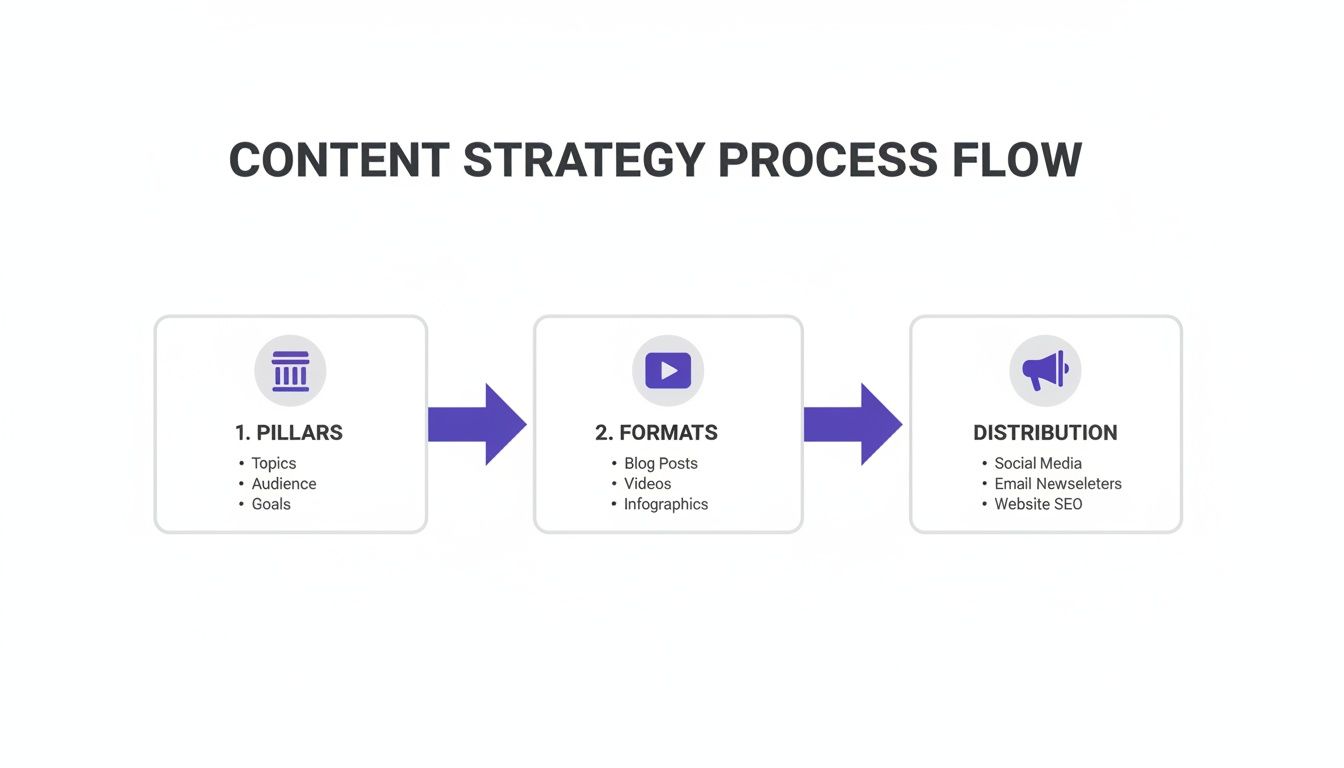
This flow shows the direct line from your foundational strategy to the specific formats you'll be posting. It's the blueprint that ensures every single piece of content has a purpose.
Designing Your Weekly Posting Rhythm
A weekly rhythm is the heartbeat of your content calendar. Instead of staring at seven blank days, you assign a specific theme or format to each day you post. This simple move brings incredible clarity and makes batch-creating your content a breeze.
Here’s a real-world example for a B2B consultant who posts four times a week:
- Monday: Industry Insight. Kick off the week by reacting to a new industry report or analyzing a current trend. A simple text-only post here can spark immediate conversation.
- Wednesday: Pillar Deep-Dive. Go deep on one of your core pillars with a detailed carousel. Maybe it’s breaking down "Lead Generation Tactics" or "Client Retention Strategies."
- Thursday: Quick Win Video. Share a 60-second video with one actionable tip your audience can use right away. Short, sweet, and valuable.
- Friday: Personal Story. End the week by connecting on a human level. Share a lesson you learned from a recent project or a business challenge you overcame.
This structure isn't set in stone; it's your guide. It ensures you’re hitting a balanced mix of content that educates, engages, and builds a genuine connection. If you need more inspiration, check out these different content calendar examples to see how others organize their weeks.
A solid weekly rhythm totally eliminates decision fatigue. You stop asking, "What should I post today?" and start asking, "What's a great Industry Insight for Monday?" The difference is massive.
Structuring Your Monthly Themes
Once your weekly cadence is locked in, you can zoom out and plan monthly themes. This adds another layer of cohesion and stops your content from feeling random. A monthly theme lets you explore one of your content pillars in much greater depth, using all your different formats.
Let's say one of your pillars is "Team Productivity." Your monthly calendar could be broken down like this:
- Week 1: Focus on "Effective Meeting Rhythms."
- Week 2: Dive into "Tools for Remote Collaboration."
- Week 3: Discuss "Avoiding Burnout and Setting Boundaries."
- Week 4: Share "Delegation Strategies for Leaders."
This thematic approach keeps your content focused and gives your audience a reason to keep coming back. A disciplined calendar truly is the backbone of success on LinkedIn. And the data backs it up—consistent, strategic content gets rewarded. To keep your calendar full without burning out, it's also smart to implement effective content repurposing strategies.
From Scheduling to Refining Your LinkedIn Performance

A great content calendar isn't something you set in stone and walk away from. Think of it as a living document that gets smarter with every post you publish. The final, and arguably most important, part of your content workflow is this cycle of scheduling, analyzing, and refining. It’s what separates a good content strategy from a truly effective one.
First up is scheduling. You want your content to land in front of your audience when they're actually online and paying attention. While there's no single magic hour for everyone, LinkedIn data consistently shows peak activity happens during business hours, especially mid-morning and mid-week. For a deeper look at timing, check out our guide on how to schedule social media posts for the best results.
Using a scheduling tool is a non-negotiable for anyone serious about consistency. Platforms like PostFlow do more than just let you batch-create your content; they also provide smart time suggestions based on when your network is most likely to engage. This kind of automation is a lifesaver, protecting your most valuable asset: your time.
Looking Beyond Vanity Metrics
Once your posts go live, the real learning begins. It’s way too easy to get caught up in likes and impressions, but these "vanity metrics" are only half the picture. To figure out what’s actually moving the needle, you have to dig into analytics that connect back to your original goals.
So, what should you really be tracking?
- Website Clicks: If lead generation is your game, this is your north star. It shows you exactly which posts are compelling people to leave LinkedIn and check out your website or landing page.
- Comments and Conversations: High-quality comments mean your content is making people think. Are they asking smart questions or sharing their own take? That’s a huge signal that you've hit on something that resonates.
- Shares and Reposts: When someone shares your content, they're basically giving it their stamp of approval to their entire network. This is powerful social proof and extends your reach way beyond your own followers.
- Follower Growth from a Post: LinkedIn’s own analytics can show you how many new followers a specific post brought in, drawing a direct line from a piece of content to audience growth.
The most valuable insight comes from finding patterns. Don't obsess over one viral post. Instead, look for the common thread among your top five performers. Is it a certain format, topic, or tone? That's your blueprint for what to create next.
The Refinement Loop In Action
This data-first approach lets you constantly fine-tune your content calendar. The process is a simple, repeatable loop: Post → Analyze → Adjust.
Let's imagine you notice your Wednesday carousel posts consistently get high shares and drive website traffic, but your Friday text-only updates fall completely flat. The adjustment is obvious: double down on what’s working with carousels and try a different format or topic for Fridays.
This isn’t about throwing your content pillars out the window. It's about optimizing how you bring those pillars to life. By using insights from your analytics, you turn your calendar from a static schedule into an intelligent system—phasing out what doesn’t work and amplifying what does. It ensures your LinkedIn strategy gets better and smarter with every single post.
Burning Questions About LinkedIn Content Calendars
Even with the best-laid plans, a few questions always pop up once you start putting a social media content calendar into action. I’ve seen these come up time and time again with professionals trying to get a handle on their LinkedIn presence, so let's tackle them head-on.
Getting these answers straight helps you move from the "planning" phase to the "doing" phase with confidence. The whole point is to build a system that feels repeatable and sustainable, not like another chore on your to-do list.
How Far in Advance Should I Actually Plan My Content?
This is all about finding that sweet spot between a long-term strategy and the agility to jump on timely conversations. If you plan too far ahead, you'll feel stuck and unable to react to a sudden industry trend. But if you plan day-by-day, you’re on a fast track to burnout and inconsistent, last-minute posts.
From what I've seen work best, aim to map out your high-level themes and content pillars about one month in advance. This gives you that crucial bird's-eye view. Then, get down to the nitty-gritty of creating and scheduling the specific, ready-to-publish posts one or two weeks out. This approach gives you a solid structure but leaves plenty of room for those spontaneous, in-the-moment ideas.
What Do I Do When I Run Out of Ideas?
Creator’s block is real, and it happens to all of us. When you feel like you’ve hit a wall, the very first thing you should do is go back to your core content pillars. Is there a new angle you haven't explored? A different story you can tell within those foundational topics? Honestly, your best source of inspiration is often sitting right in your notifications.
What questions are people asking in your comments or DMs? What problems are your clients bringing up on calls? Each of these is a ready-made content topic waiting to be addressed.
Don't forget to look back at your greatest hits, either. That text-only post that sparked a massive debate a few months ago? That could be your next insightful carousel. That quick video tip you shared? It could easily be expanded into a more detailed, helpful article. Never, ever underestimate the power of repurposing what has already resonated with your audience.
What's a Realistic Posting Frequency for LinkedIn?
On LinkedIn, consistency is king. It will always, always beat raw frequency. It’s far more powerful to share three high-quality, thoughtful posts every single week than it is to post daily for one week and then go silent for the next two. The algorithm notices, and more importantly, your audience notices. They both reward reliability.
For most professionals I work with, a realistic and incredibly effective target is 3-5 posts per week. This cadence keeps you visible and top-of-mind without completely overwhelming your network or—let's be real—yourself. The key is to choose a schedule you can genuinely maintain for the long haul. Your content calendar is the tool that makes this sustainable rhythm possible.
How Do I Know if My Content Is Actually Working?
Measuring success circles right back to the goals you set in the very beginning. If your main objective was to build brand awareness, then you need to be tracking metrics like follower growth, post impressions, and shares. These numbers tell you how far and wide your message is spreading.
But if your goal was lead generation, your focus should be on completely different numbers. You’ll want to track website clicks from your LinkedIn profile, the number of DMs from qualified prospects, and how many new connection requests you're getting from people in your target industry. Success isn't just about likes and comments; it's about tying your content efforts to real, tangible business outcomes.
Stop missing opportunities on LinkedIn. Let PostFlow help you turn your expertise into consistent, engaging content that grows your business. Get started with PostFlow today!