
If you're running a small business, using LinkedIn to find clients and build your brand isn't just a good idea—it's practically essential. This isn't just another social media app to add to your already-full plate. It’s the one place where your ideal clients are actively looking for solutions, making it an absolute goldmine for growth.
Why LinkedIn Is a Non-Negotiable for Your Business
I get it. For many small business owners, from B2B consultants to local service providers, LinkedIn can feel like just one more box to check. But that mindset is exactly what holds most people back.
Think of it this way: unlike other platforms designed for endless scrolling and casual entertainment, LinkedIn is built for professional networking, industry learning, and real problem-solving. Every piece of content you share, every comment you leave, and every connection you make lands with an audience that's already in a business frame of mind. This is where you build genuine credibility, not chase fleeting trends.
A Goldmine of High-Value Connections
The sheer number of professionals on LinkedIn is hard to ignore. We're talking about a platform with 1.2 billion members globally, making it the undisputed heavyweight champion of professional networking.
But it’s not just about the raw numbers. It's about who those numbers represent.
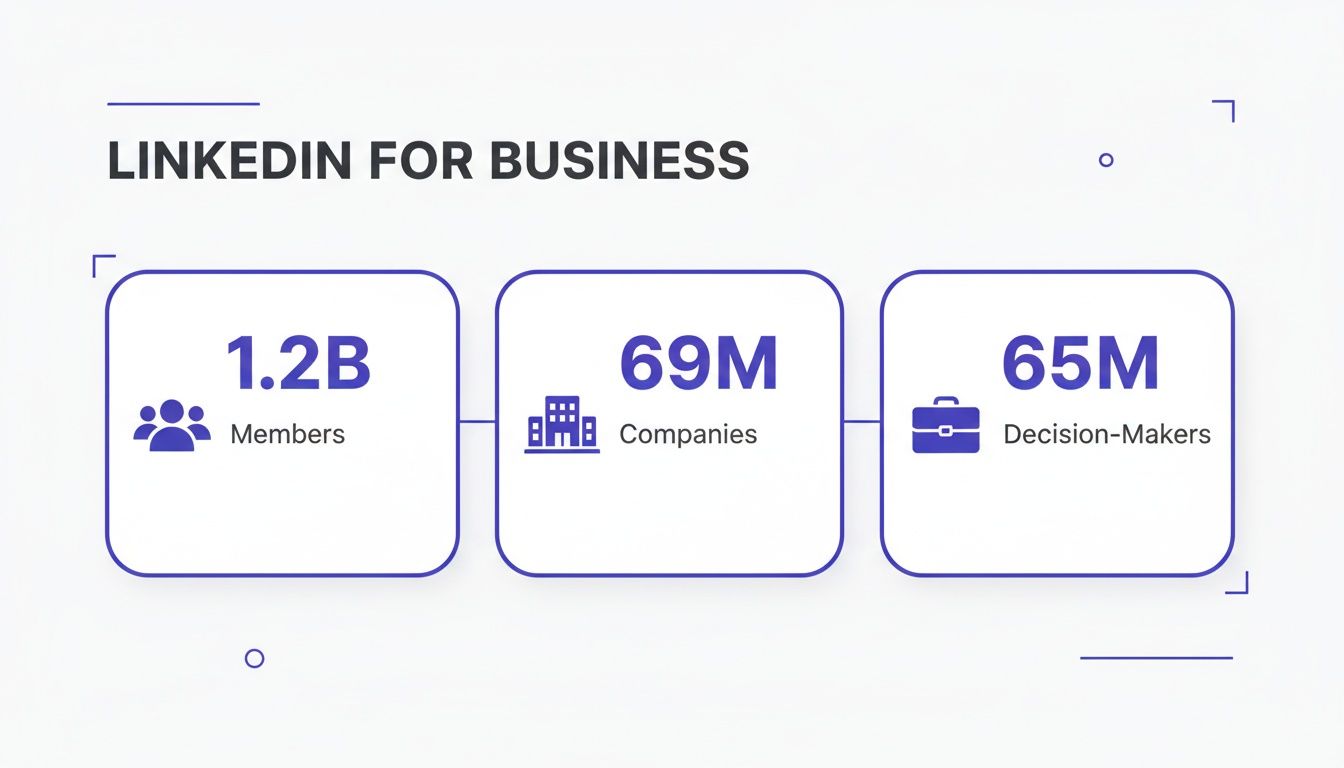
For a quick snapshot of the opportunity waiting for you, check out these figures.
LinkedIn Opportunity Snapshot for Small Businesses
A quick overview of key statistics that highlight why LinkedIn is a critical platform for small business growth and client acquisition.
| Metric | Statistic | Why It Matters for Your Business |
|---|---|---|
| Total Members | 1.2 billion | Unmatched global reach to find clients, partners, and talent in any niche. |
| Companies on Platform | 69 million | Direct access to your target accounts, allowing for strategic B2B outreach. |
| Decision-Makers | 65 million+ | You can bypass gatekeepers and connect directly with the people who sign the checks. |
| High-Income Users | 44% earn over $75k | The audience has significant purchasing power and is ready to invest in solutions. |
These numbers tell a clear story: your next big client, your dream strategic partner, or your next key hire is on LinkedIn right now. The only question is whether they can find you. For a deeper dive, you can explore more LinkedIn business statistics to see just how powerful this audience is.
More Than Just a Digital Rolodex
One of the biggest mistakes I see business owners make is treating LinkedIn like a dusty old address book—a place to collect contacts and then forget about them. That's a huge missed opportunity.
LinkedIn is your digital storefront, your networking event, and your industry conference all rolled into one. Consistent, authentic activity here doesn't just get you seen—it gets you remembered and trusted.
When you consistently share valuable insights and engage in real conversations, your profile transforms from a static resume into a dynamic lead-generation machine. You're not just networking; you're building a reputation as the go-to expert in your field. This is how you attract opportunities directly to you, making those sales conversations a whole lot easier.
Optimizing Your Profile to Attract Ideal Clients
Before you even think about posting your first piece of content, we need to talk about your digital storefronts: your personal LinkedIn profile and your Company Page. Too many small business owners treat these as an afterthought—a digital resume or a simple business listing. That’s a huge mistake.
Think of them as high-converting landing pages that work for you around the clock. They need to be tuned to stop your ideal clients mid-scroll and immediately show them you have the solution they’ve been looking for.

The secret isn't to talk about yourself. It’s to speak directly to your ideal customer. Focus on their problems, their goals, and how you're the one who can get them there.
Crafting a Magnetic Personal Profile
Your personal profile is usually the first place a potential client will interact with you. It’s where you, the founder or expert, build that crucial layer of personal credibility and trust. A great profile doesn't just list what you've done; it tells a story that makes your target audience feel understood.
Your headline is the most valuable piece of real estate you have. Don’t waste it on just a job title. Instead, make it a benefit-driven powerhouse.
- Before: "Founder at ABC Consulting"
- After: "Helping B2B SaaS Founders Cut Customer Churn by 30% | Customer Retention Strategist"
See the difference? The "after" version instantly grabs the right person's attention, promises a real result, and uses keywords they might actually search for. It’s a full-blown marketing message in one line.
Your LinkedIn headline isn't just a title; it's your elevator pitch. Make every character count by focusing on the outcome you deliver for your clients, not just the service you provide.
Now, carry that promise into your "About" section. Write it like you’re having a conversation, and make it easy to scan. Kick it off with a hook that digs into your client's biggest pain point. Then, walk them through how you solve it and what makes you the best choice. Wrap it up with a clear call to action—ask them to connect, book a call, or check out your website.
Leveraging the Featured Section for Social Proof
The "Featured" section is your secret weapon for building instant credibility, but so few people use it strategically. This is where you get to show, not just tell. It’s your portfolio, right on your profile.
Here are a few things you should be featuring:
- Client Testimonials: A quick video or a sharp-looking graphic with a quote that sings your praises.
- Case Studies: A link to a blog post or a PDF that breaks down a specific client win with real numbers.
- Lead Magnets: Offer a valuable freebie like an e-book or a checklist. It’s a great way to generate leads directly from your profile.
- Your Best Content: Pin that killer LinkedIn post that got a ton of engagement or an article you wrote that perfectly explains your philosophy.
This section provides the proof that backs up all the claims you made in your headline and "About" section. It shows you can walk the walk.
Building a Trustworthy Company Page
While your personal profile builds your authority, your Company Page makes your business official. A polished, complete page is non-negotiable for looking legit. The numbers don't lie: companies with complete profiles get 30% more weekly views. That's a serious edge.
Your page's tagline should be a short, punchy summary of your company's value proposition. Use the "About" section to tell your brand's story, and be sure to weave in keywords your clients would use to find a business like yours.
A few more essential tweaks for your Company Page:
- Custom Button: Don't just stick with the default "Visit website." Change it to "Learn more" and point it to a specific service page, or try "Sign up" to drive traffic to your newsletter or a webinar.
- High-Quality Visuals: Make sure your logo and banner image are professional and sized correctly. Use that banner space to reinforce your tagline or show off the human side of your company with a team photo.
- Employee Connection: Get your whole team to link their personal profiles to the Company Page. This boosts your page's visibility every time they connect with someone and adds social proof by showing off the size of your team.
When you treat your personal profile and Company Page as strategic assets, you create a powerful one-two punch that attracts, engages, and converts the clients you actually want to work with.
Developing a Sustainable Content Strategy
An optimized profile is your digital handshake, but a consistent content strategy is what actually builds the relationship. I get it—for most small business owners, the thought of posting on LinkedIn every day feels like another full-time job.
Here’s the secret: it’s not about posting constantly. It’s about posting with purpose. It’s about creating a rhythm that feels authentic to you and, more importantly, is manageable for the long haul. This is how you turn your expertise into valuable content without burning out. A clear plan gets rid of that daily "what do I post?" pressure and lets you focus on just sharing what you already know.
The real goal here is to build your authority and stay top-of-mind with your ideal clients.

Building Your Core Content Pillars
Stop chasing random content ideas. Instead, anchor your entire strategy in a few core "content pillars." Think of these as the foundational topics that sit at the intersection of your expertise, your audience's pain points, and your business goals. For a small business, this is a game-changer for simplifying content creation.
Your pillars are like the main chapters in a book about your business. A B2B consultant might build their content around pillars like "Leadership Development," "Team Productivity," and "Scaling Operations." For a marketing agency owner, it could be "Lead Generation," "Brand Storytelling," and "Content ROI."
Having these pillars gives your content direction. They act as a guardrail, preventing you from drifting into topics that don’t serve your audience or reinforce your brand. This makes your LinkedIn for small business strategy exponentially more effective.
Types of Content That Actually Perform
Once your pillars are set, it’s time to think about how you’ll talk about them. Variety is everything when it comes to keeping your audience from scrolling past your posts. We know that businesses posting weekly on LinkedIn see 2x the engagement, so mixing up your formats is a smart way to hit that consistency.
Here are a few proven formats to keep in your rotation:
- Behind-the-Scenes Stories: People do business with people, not logos. Share the real stuff—the wins, the messy lessons learned from a project, or even just a snapshot of your workspace. It humanizes your brand and builds incredible trust.
- Valuable How-To Guides: Break down something complex into simple, actionable steps. A financial advisor could kill it with a carousel post on "5 Steps to Prep for Year-End Tax Planning." This immediately positions you as a helpful expert.
- Client Success Spotlights: With their permission, of course, showcase a client's win. But don't just talk about the service you provided; focus on the transformation they experienced. This is social proof on steroids.
- Industry Insights and Opinions: Don't just regurgitate news. Interpret it. Share your unique take on a recent industry trend or challenge a common assumption. This is how you build a reputation as a thought leader and spark real conversations.
The best LinkedIn content doesn't just inform; it starts a conversation. Always look for ways to ask a question, share a bold opinion, or tell a relatable story. Your goal is to give people a reason to stop scrolling and engage.
This approach keeps your feed fresh and interesting, and it appeals to different people in your audience who prefer different types of content. For a deeper dive, you can explore this comprehensive LinkedIn content strategy framework that breaks these ideas down even further.
Creating a Simple Weekly Workflow
Consistency is built on systems, not sheer willpower. A simple weekly workflow is what separates the people who post for a month and quit from those who build a real presence. You don't need a complex, color-coded spreadsheet—you just need a plan.
Here's a manageable weekly schedule you can steal:
- Monday: Kick off the week with an insightful post tied to one of your core pillars. A strong, text-only opinion post works great here to spark immediate engagement.
- Wednesday: Time for some "human" content. This is your slot for a behind-the-scenes look at the business, a personal story, or a shout-out to a team member.
- Friday: End the week by delivering pure value. This could be a short how-to guide, a client success story, or a carousel breaking down a useful tip. Leave people with something tangible.
This three-post-a-week rhythm is incredibly sustainable for most small business owners. It gives you enough touchpoints to stay visible without demanding hours of your time every single day. The pro move? Batch-create these three posts in one sitting, schedule them out, and get back to running your business. This simple system turns a daunting task into a manageable habit.
How to Network and Engage Authentically
Look, pumping out great content is only half the job on LinkedIn. The real magic—the kind that actually moves the needle for your business—happens in the DMs and comment threads. Think of your posts as the opening line at a networking event; your engagement is the conversation that follows.
This is where I see so many small businesses drop the ball. They post something and then ghost, treating LinkedIn like a one-way billboard instead of a two-way street. To win here, you have to stop broadcasting and start building a community.
Go Beyond Generic Comments
We’ve all seen them. The endless scroll of "Great post!" or "Thanks for sharing!"
While the intention is good, these comments are the digital equivalent of a polite nod. They’re forgettable. They do absolutely nothing to establish you as an expert or get people curious about what you do.
Real engagement means adding something to the conversation. Your goal is to leave a comment so insightful it could almost be its own mini-post. This one shift in approach will dramatically boost your visibility, I promise. People see a thoughtful contribution and their first instinct is to click on your profile to see who you are.
Here’s a simple framework for leaving comments that actually get noticed:
- Share a quick story: "This really hits home. We faced a similar issue last year and found that [specific tactic] made a huge difference for our team."
- Ask a smart question: "Love this take. How do you think this trend will play out for bootstrapped startups without huge marketing budgets?"
- Drop a relevant stat: "Fantastic analysis. What’s wild is that a recent study found 68% of companies are also struggling with this, which just shows how massive this problem is."
This approach takes your comments from background noise to valuable, attention-grabbing insights.
Manage Your Own Post Engagement
When someone takes the time to comment on your stuff, it’s a golden opportunity. Don't just leave them hanging. You need to be an active host, not an absent publisher. A thoughtful reply shows you’re actually listening and helps build a real community around your work.
Don’t just "like" their comment—reply to it. Acknowledge what they said and, if it makes sense, ask a follow-up question to keep the ball rolling. The more back-and-forth you can spark in the first few hours after posting, the more the LinkedIn algorithm will reward your content with a wider reach.
Responding to comments isn't just about being polite; it’s a strategic move. Every single reply signals to the algorithm that your post is sparking a valuable discussion, which in turn boosts its visibility and attracts even more people to the conversation.
Send Connection Requests That Actually Work
The connection request is one of the most powerful tools on LinkedIn, but man, is it misused. Firing off a generic, empty request is a completely wasted opportunity. That little personalized note is your shot to make a great first impression and be clear about why you want to connect.
And please, forget the sales pitch. Your first message should be about them, not you. A simple, non-spammy formula that works like a charm is to mention a specific post of theirs you liked or a shared interest.
Here’s a personalized request that doesn't feel gross:
"Hi [Name], I really enjoyed your recent post on [topic]. Your insights on [specific point] were incredibly helpful. I'm also passionate about this space and would love to connect and follow your work."
This shows you’ve actually paid attention and are interested in connecting for the right reasons, not just to boost your follower count. This small tweak can radically increase your acceptance rate. To really level up your networking game, you should also check out these 8 unbeatable professional networking tips. By focusing on genuine interactions, you’ll turn LinkedIn from a chore into your most powerful networking asset.
Turning Your Connections into Loyal Customers
Getting people to engage with your content is a huge win, but it's only half the battle. The real trick for any small business owner is converting those likes, comments, and connections into actual business without coming off as a pushy salesperson.
This is where you need to master the subtle art of lead nurturing on LinkedIn.
Forget those aggressive, copy-paste sales pitches that flood everyone's DMs. The goal here is to shift a public conversation into a private one at just the right moment, with a message that feels helpful, not hungry. When you get this right, it feels like a completely natural next step in the relationship you’ve already started building.
Recognizing Subtle Buying Signals
Your network is constantly dropping hints about their needs, their frustrations, and what they’re looking for. Your job is to get good at spotting them. These "buying signals" are rarely a direct, "I need to hire someone for this!" post. They’re usually much quieter.
Learning to pick up on these cues is a core skill for using LinkedIn for small business growth. They tell you exactly when it’s the right time to reach out.
Here are a few of the big ones I always watch for:
- They ask specific questions. When a connection posts something like, "Does anyone have experience with [a problem you solve]?"—that's a direct invitation to jump in and help.
- They announce a new role or project. Someone just starting a new leadership position often has the budget and the motivation to bring in outside help to score a quick win.
- They engage with competitor content. If you notice a prospect regularly liking or commenting on posts from your competitors, you know they're actively researching solutions in your space.
- They voice a specific frustration. A post venting about a challenge, like "Our lead quality has been terrible this quarter," is an open door for you to offer a real solution.
These moments are your green light. They give you the perfect reason to slide into their DMs with a message that’s helpful, not salesy.
Starting a Natural Sales Conversation
Once you spot a signal, your first message needs to be all about adding value, not pitching your services. Think of yourself as a problem-solver first and a vendor second. Whatever you do, avoid the immediate pitch.
Instead, frame your outreach around their situation. A great message might look something like this:
"Hey [Name], I saw your post about the challenges with [the problem they mentioned]. That can be a really tricky area. I actually put together a quick guide on that for another client a while back that you might find useful. Happy to send it over if you're interested—no strings attached."
This approach nails several things at once. It proves you're paying attention, it offers immediate value without asking for anything in return, and it respects their time by asking for permission to share. You aren't selling; you're helping.
This value-first method is how you build a pipeline of warm, qualified leads who already see you as a trusted expert. For a deeper dive into this process, our guide on how to generate leads on LinkedIn breaks down even more actionable frameworks.
By doing this, the eventual shift to a sales discussion feels earned and welcome, not abrupt and annoying. And that dramatically boosts your chances of turning a connection into a long-term, loyal customer.
Using Analytics to Refine Your LinkedIn Approach
Posting content and chatting with your network is a solid start, but a truly effective strategy is built on data, not just good vibes and guesswork. Digging into your analytics is how you figure out what’s actually working so you can do more of it. This is where we demystify LinkedIn’s data, giving you the confidence to measure your efforts and make smart decisions that fuel real growth.
Without looking at the numbers, you're basically posting in the dark. Analytics turn on the lights, showing you what your audience truly cares about. It’s how you shift from a reactive content plan to a proactive, data-informed one.

Key Metrics That Actually Matter
When you first pop open your analytics dashboard, it can feel like a lot. The secret is to cut through the noise and ignore the vanity metrics. Instead, focus on the numbers that signal genuine connection and tell you if you're reaching the right people.
Here are the core numbers I always keep an eye on:
- Impressions: This is simply how many times your post was shown in someone's feed. A high number feels good, sure, but it’s a surface-level metric. I use it as a baseline to see if my content's reach is growing over time.
- Engagement Rate: This is the big one. It's the total number of interactions (likes, comments, reposts) divided by your total impressions. A high engagement rate tells the algorithm—and, more importantly, you—that your content is genuinely hitting the mark.
- Follower Demographics: Pay close attention to the job titles, industries, and locations of your new followers. Are these the folks you actually want to do business with? If there's a mismatch, it’s a clear sign you need to tweak your content pillars.
Interpreting Your Post Analytics
Every single post you make tells a story. Take a look at your top-performing content from the last 30 days. Do you notice any patterns? Maybe your audience goes wild for short video tips but scrolls right past your text-only posts. Or maybe those behind-the-scenes stories get way more comments than industry news roundups.
These insights are pure gold. They give you a clear roadmap for what to create next, taking the guesswork out of your content calendar. To go deeper on this, you can check out our guide on how to analyze content performance and apply those same principles right here on LinkedIn.
Don’t just glance at the numbers; ask why they look that way. A post with low impressions but a crazy high engagement rate might have struck a chord with a small, highly relevant niche—and for a small business, that’s a massive win.
A Simple Monthly Review Checklist
To make this a habit that sticks, block off 30 minutes at the end of each month for a quick review. This simple ritual will continuously sharpen your LinkedIn strategy without eating up your entire day.
Your Monthly LinkedIn Check-In:
- Identify Top 3 Posts: Which posts had the highest engagement rate? Note their topic and format (e.g., carousel, video, poll).
- Identify Bottom 3 Posts: Which posts fell flat? Be honest about why they might not have connected.
- Review Follower Growth: How many new, relevant followers did you gain?
- Analyze Follower Quality: Flip through the profiles of your new followers. Do they fit your ideal client persona?
- Set One Goal for Next Month: Based on what you learned, what’s one small adjustment you can make? Maybe it's "Create two more carousel posts" or "Focus more on the 'Team Productivity' pillar."
This simple, repeatable process turns your analytics from a confusing dashboard into your most valuable strategic tool. It ensures your LinkedIn for small business efforts are driving sustainable, long-term results.
Got Questions About LinkedIn? You're Not Alone.
Even with a solid game plan, a few questions always pop up when you're getting serious about using LinkedIn to grow your business. I've heard these from countless founders and consultants, so let's tackle them head-on.
Is LinkedIn a Waste of Time for B2C?
Not at all. While LinkedIn is definitely a B2B powerhouse, it's a goldmine for B2C businesses selling high-ticket items or services. Think financial advisors, real estate agents, high-end coaches, or custom home builders.
It’s all about targeting the right people. With 44% of users earning over $75,000 a year, you’re not shouting into the void; you’re connecting with an audience that has real purchasing power. The goal isn't mass-market ads, it's about building trust and authority with the specific individuals who can afford what you offer.
Seriously, How Much Time Do I Need to Spend on This Daily?
Consistency will always beat cramming. You absolutely do not need to live on the platform to get results.
A focused 15-20 minutes a day is way more powerful than a two-hour binge session once a week. Use that time to reply to comments, engage with a few key people in your network, and share one thoughtful piece of content.
This small daily habit creates momentum without burning you out. It's what makes your strategy stick for the long haul.
Personal Profile vs. Company Page: Where Should I Put My Energy?
For a small business, your personal profile is the engine. Period. People buy from people they know, like, and trust—not from faceless logos. Use your personal profile to build your authority, share your story, and actually talk to people.
Think of your Company Page as your business's official "home base." It makes you look legitimate, it’s a great spot for your evergreen content, and it’s where your team can link back to.
A good rule of thumb? Pour 80% of your effort into your personal profile and use the other 20% to keep the Company Page looking sharp and up-to-date. For most small businesses, that's the sweet spot for getting real results.
Stop letting opportunities on LinkedIn pass you by. PostFlow can help you turn your expertise into a consistent flow of engaging content that actually grows your business. See how it works at https://gopostflow.com.