
Getting more eyes on your blog comes down to nailing three things: getting your SEO basics right, creating content that actually pulls in your ideal readers, and then getting that content in front of them. Forget chasing the latest flashy trend. This is about building a solid, reliable engine that drives real business results.
Your Blueprint for Sustainable Blog Growth
Struggling to get your blog traffic off the ground? You're not the only one. It's a common headache, but let's look at it differently. For founders, consultants, and creators, traffic isn't just a number to brag about—it's the fuel for lead generation and sales. The secret isn't some magic bullet; it's a systematic approach that delivers compounding returns over time.
This guide skips the fluff and gives you a clear, actionable playbook. I'm going to show you how to weave together three critical elements that build on each other to increase your blog traffic. When you get this foundation right, your blog becomes an asset that works for you 24/7, quietly bringing in traffic and potential customers for years to come.
The Three Pillars of Traffic Growth
Your path to sustainable growth starts with a solid foundation. If you're just starting out, our detailed guide on how to start blogging is a great place to get your setup right from day one. Once you're up and running, it's all about focusing on these key areas:
- Master Foundational SEO: This is all about making sure people can find you. It covers everything from on-page optimization and keyword research to the technical health of your site, ensuring search engines can easily find and favor your articles.
- Strategic Content Creation: This is where you shift from just writing posts to building a content machine. Think high-value pillar content, strategically updating old posts to keep them fresh, and repurposing your best work to get the most mileage out of it.
- Intelligent Distribution & Promotion: Even the best content is useless if no one sees it. This means you have to actively promote your work through your email list, on social channels like LinkedIn, and with smart outreach to get your articles in front of the right people.
The blogs that truly succeed don't just publish; they build systems. A consistent blogging schedule paired with a repeatable promotion checklist is what separates the blogs that grow from the ones that just… exist.
To really build out this blueprint, you need to understand the nuts and bolts of boosting your organic reach. For a deeper dive, this helpful guide on how to increase organic traffic offers some practical tips that line up perfectly with what we're talking about here. By zeroing in on these fundamentals, you turn your blog from a simple publication into a powerful marketing tool that delivers consistent, measurable growth.
Master Foundational SEO for Immediate Impact
If you want more blog traffic, you can't sidestep search engine optimization (SEO). But let's get one thing straight: you don’t need to be a technical wizard to see some serious results. SEO is really just about making it easier for search engines like Google to find, understand, and show your content to the right people.
Think of it this way: your blog is a massive library, and each post is a book. Without a solid organizational system (that’s your SEO), readers will never find the brilliant books you’ve written. By getting a handle on a few core principles, you can give your visibility and traffic an immediate shot in the arm.

Nail Your On-Page SEO Checklist
On-page SEO is all about the tweaks you make directly on your blog posts. These are the signals that tell Google what your content is about and which search queries it should rank for. Getting this right isn't optional if you're serious about sustainable traffic.
Here’s a practical checklist to run through for every single article you publish:
- Keyword Research: Before you type a single word, figure out the primary keyword your audience is searching for. Free tools like Google Keyword Planner are great, but paid options like Ahrefs give you a competitive edge. The goal is to pinpoint the exact phrases people use when they need the solution you offer.
- Compelling Meta Descriptions: This is the little snippet of text that shows up under your title in the search results. While it’s not a direct ranking factor, a killer meta description convinces people to click on your link instead of someone else's. Make it a short, persuasive summary of what the reader is about to learn.
- Optimized Image Alt Text: Search engines can’t "see" images, so they rely on alt text to understand what's in them. It's a short, descriptive tag. Always try to include your primary keyword (or a close variation) in the alt text for at least one image in your post. So, instead of "image123.jpg," your alt text should be something like "on-page SEO checklist for increasing blog traffic."
The difference between a page that gets impressions and one that gets clicks often comes down to the title and meta description. Spend as much time crafting these as you do on your article’s introduction. It's your one shot to capture attention in a crowded search results page.
Build a Strong Internal Linking Structure
Internal links are just hyperlinks pointing from one page on your site to another. A smart internal linking strategy does two incredibly powerful things: it helps search engines discover all your content, and it passes authority (or "link equity") between your pages, making your whole site stronger.
For instance, if you have a high-performing article about content strategy, you should absolutely link from it to newer, related posts about topic research or content distribution. This simple move tells Google, "Hey, this new post is important and related to a topic you already trust me on." It also keeps readers clicking around your site longer, which is a fantastic engagement signal. Our guide to business blogging best practices dives deep into creating a content ecosystem that makes this strategy work.
Find and Fix Low-Hanging Fruit
One of the absolute quickest ways to get a traffic boost is to find pages that are almost ranking well and give them a nudge. This is where a free tool like Google Search Console becomes your best friend.
Look for pages that get tons of impressions but have a painfully low click-through rate (CTR). This usually means your page is showing up in search results, but the title or meta description isn't grabbing anyone's attention.
Here's a simple process to follow:
- Log in to Google Search Console and head over to the "Performance" report.
- Filter your results to show pages that have a lot of impressions but a CTR below 3%.
- Take a hard look at these pages. Are the titles boring? Are the meta descriptions generic?
- Rewrite them. Make them more engaging and ensure they directly answer the searcher's question.
By just improving the headlines and descriptions for these "almost-there" pages, you can often double their traffic without writing a single line of new content. To make sure all your content is easily discoverable, mastering how to write SEO friendly blog posts is the key to unlocking higher visibility.
Develop a Content Strategy That Attracts Your Ideal Readers
Throwing random blog posts at the wall and hoping something sticks is a recipe for burnout. Trust me, I’ve seen it happen. If you want to actually increase your blog traffic, you need to stop thinking like a writer and start thinking like an architect.
Every piece of content you create needs a purpose. It needs to fit into a larger structure that builds your authority and, more importantly, pulls in the right kind of reader.
The single best way I’ve found to do this is the pillar-and-cluster model. It’s not just an SEO tactic; it's a complete shift in how you approach content, and it works wonders for getting Google (and your audience) to see you as an expert.

Build Topical Authority with Pillar and Cluster Content
So, what does this model look like in practice? Imagine you’re building a mini-encyclopedia on a core topic for your business.
Pillar Page: This is your cornerstone. It's a massive, comprehensive guide that covers a broad topic from A to Z. For instance, a B2B consultant might create a pillar page on "The Ultimate Guide to Lead Generation." It’s long, detailed, and touches on all the key subtopics without getting lost in the weeds on any single one.
Cluster Content: These are the deep dives. They're shorter, highly-focused articles that explore one specific subtopic from your pillar page in detail. Using our lead-gen example, your cluster posts could be titles like, “10 High-Converting Landing Page Designs,” or “How to Write a Cold Email That Actually Gets a Reply.”
The magic happens with the internal links. Every cluster post links back up to the main pillar page. In return, the pillar page links out to each of its supporting cluster articles. This creates a beautifully organized web of content that screams expertise to search engines, building what’s known as topical authority. The more authority you have, the better all of your related content starts to rank.
When your content is interconnected this way, you create a "sticky" experience. A visitor might find your cluster post on email marketing, click through to your massive pillar guide on lead generation, and then discover another cluster about LinkedIn tactics. Boom. You just turned one page view into three, all while delivering incredible value.
The data backs this up. In-depth, high-quality content consistently performs better. Research shared by Databox in their blogging statistics report shows a clear correlation between longer blog posts and higher search rankings. Over time, these well-ranked articles become compounding assets, driving a steady stream of traffic and leads for years.
Choosing the right content strategy is critical. Some approaches deliver faster results, while others are a long-term play. To help you decide where to focus your energy, here’s a quick comparison of the ROI you can expect.
Content Strategy ROI Comparison
| Strategy | Effort Level | Typical Traffic Impact (6-12 Months) | Best For |
|---|---|---|---|
| New Pillar/Cluster | High | +50-200% on target topics | Establishing authority in a new niche. |
| Content Refresh | Low | +20-50% on existing posts | Quick wins and reviving declining content. |
| Content Repurposing | Medium | +10-30% (multi-channel) | Maximizing reach across different platforms. |
| Guest Posting | Medium | Variable (referral + authority) | Building backlinks and brand awareness quickly. |
Ultimately, a balanced approach works best. Start with the low-hanging fruit (content refreshes) while you chip away at a bigger pillar-and-cluster project.
The Art of the Content Refresh
Speaking of quick wins, one of the most underrated traffic-boosting tactics is simply updating what you already have. You don’t always need to create something from scratch.
Dive into your analytics and look for posts that are "almost there"—articles that get some impressions but few clicks, or posts that used to be popular but have started to decline. These are gold mines.
- Find your underperformers: Look for content with outdated stats, broken links, or information that just isn't relevant anymore.
- Update and expand: Don’t just fix a typo. Add entirely new sections, embed a recent video, or include fresh, real-world examples. Your goal is to make it undeniably better.
- Optimize the on-page stuff: Rewrite that boring title and meta description. Double-check that your target keyword is still the right one and update internal links to point to your newest content.
- Republish and promote: This is key. Change the publish date to today and push it out on social media and to your email list as if it’s brand new.
Maximize Your Reach by Repurposing Content
You just spent hours, maybe even days, creating an amazing blog post. Don't just let it sit there. Repurposing is the art of taking that one core asset and spinning it into a dozen different formats for different platforms.
It’s all about working smarter. A single, well-researched article can fuel your content calendar for weeks.
| Original Content | Potential Repurposed Formats | Target Platform |
|---|---|---|
| Blog Post | A 2,000-word guide on "How to Increase Blog Traffic." | Your Website/Blog |
| Infographic | A visual summary of the "Pillar-and-Cluster Model." | Pinterest, Social Media |
| Video | A YouTube tutorial on "How to Do a Content Refresh." | YouTube, LinkedIn |
| LinkedIn Post | A key takeaway about on-page SEO from the article. | |
| Carousel | A 10-slide breakdown of "5 Steps to Build a Content Cluster." | LinkedIn, Instagram |
| Email Series | A 3-part nurture sequence on traffic-building strategies. | Email Newsletter |
When you strategically plan, refresh, and repurpose, you stop being just a blogger and become a true content architect. You're building a library of interconnected assets that work together to bring in your ideal audience, day in and day out.
Amplify Your Reach with Smart Distribution Tactics
Hitting "publish" on a great article is only half the job. I've seen it a thousand times: brilliant content that goes nowhere because there wasn't a distribution plan. Without one, even the most insightful post will just collect digital dust.
This is the moment you switch gears from creator to marketer. The goal isn't a one-off traffic spike. It's about building repeatable systems that consistently bring your ideal readers back to your blog. It’s time to ditch the "publish and pray" approach for good.

Transform Your Email List into a Traffic Engine
Your email list is your single most valuable marketing channel. Forget fighting unpredictable social media algorithms—this is a direct line to people who have already said they want to hear from you.
Don't just blast out a generic link. Craft a compelling email with a personal story or some extra context that isn't in the article. Tease the best takeaway, but make them click through to get the full picture. This simple shift shows you respect their time and trains them to open your emails every single time.
Dominate Your Niche with a LinkedIn Content System
LinkedIn is a powerhouse for blog traffic, but most people get it completely wrong. They just drop links and run. The real key is to create native content that adds value right there in the feed. A great place to start is by looking at these proven content distribution strategies that you can adapt for LinkedIn or any other platform.
The secret is to treat your blog post as a source of "micro-content." Pull out key ideas and reshape them into formats that LinkedIn's algorithm loves.
- Text-Only Posts: Grab one counterintuitive idea from your post. Write a short, punchy take on it and end with a question to get people talking.
- Carousels (PDFs): Turn your blog post's main sections into a 5-10 slide carousel. Each slide gets a bold headline and one core idea. The final slide? A clear call-to-action to read the full article.
- Video Summaries: Film a quick 60-second video of you explaining the single biggest takeaway from the article. It’s personal, and it stops the scroll.
So many people treat LinkedIn like a content graveyard where they just dump links. Think of it as a movie preview instead. Give your audience a killer trailer (your native post) that makes them desperate to buy a ticket to the full show (your blog article).
With over 1.2 billion members, the opportunity is massive. Data from Semrush, cited by Sprout Social, showed the platform pulled in 1.77 billion visits in a single month. Pages that post weekly see 5.6x more follower growth, which means you’re building a bigger, more engaged audience for every article you publish. You can discover more about LinkedIn's powerful reach and see why it’s a must for B2B.
Engage in Communities Without Being Spammy
Places like Reddit, Quora, and niche forums can be goldmines for traffic, but you have to play the long game. The rule is simple: give, give, give, then ask.
Show up and be genuinely helpful. Answer questions and offer advice without dropping a single link. Once you've built up some goodwill and a reputation, you can start sharing your content—but only when it's the perfect, most thorough answer to someone's problem. Your link should feel like a solution, not a sales pitch.
Tap into New Audiences with Strategic Guest Posting
Guest posting is a classic for a reason: it works. It’s a powerful two-for-one punch. First, you get your name and your expertise in front of a brand-new, highly relevant audience.
Second, you earn high-quality backlinks, which is a huge signal to Google that your site is an authority worth ranking. Don’t just spam every blog you can find. Create a shortlist of sites your dream customers already love and trust. Then, craft a personalized pitch with a topic idea so good they can’t ignore it. One strategic guest post on a top-tier site is worth more than a dozen on blogs nobody reads.
Build Authority with Strategic Backlinks and Outreach
Let's talk about the internet's version of a popularity contest: backlinks. Think of them as votes of confidence. When another legit site links to your blog, it's a massive signal to Google that you know what you're talking about. It tells search engines your content is trustworthy, and this is one of the single most powerful levers you can pull for long-term traffic growth.
But forget everything you've heard about spammy link-building tactics or begging for links in cold emails. That's a waste of time. The real play here is to earn high-quality backlinks from sites that are actually relevant to what you do.
Seriously, one single link from a respected industry leader is worth a hundred times more than a pile of links from sketchy, irrelevant websites.
Create Link-Worthy Assets
First things first: you can't earn links if you don't have anything worth linking to. Not every article you write is what we'd call a "linkable asset." Your standard blog posts are great for your readers, but they often don't have that special something that makes another editor or writer want to point their audience your way.
If you want to attract backlinks without even asking, you need to create content that stands out as a genuine resource.
- Original Research & Data: Run your own surveys, dig into industry data, or pull together stats nobody else has. When you're the primary source for a compelling piece of data, other blogs and even journalists will link back to you. It's a natural win.
- Ultimate Guides & Tools: Go deep. Create the most comprehensive, all-in-one guide on a specific topic. Or, better yet, build a free tool, a handy checklist, or a template. These are link magnets because they provide immediate, tangible value.
Imagine a marketing agency publishing a report called "The State of B2B LinkedIn Engagement," packed with fresh survey data. That piece of content instantly becomes a go-to source. Other marketing blogs will cite it for months, driving referral traffic and building authority all at once.
Master the Art of Smart Outreach
Okay, so you've created an incredible asset. Now what? You can't just hope people find it. This is where a little smart outreach goes a long way. I'm not talking about blasting out a generic email to a hundred people. It’s about building real relationships by offering value before you ever ask for anything.
One of the most effective—and ethical—ways to do this is broken link building.
It sounds technical, but the concept is dead simple:
- Find a relevant article or resources page on a high-authority site in your space.
- Use a free browser extension like "Check My Links" to scan the page for any dead outbound links.
- Shoot a quick, friendly email to the site owner or editor to give them a heads-up.
Here's the secret sauce: Your first email should never ask for a link. Frame it as you doing them a favor. You're just a helpful person pointing out a broken link on their site. Then, you can casually suggest your resource as a potential replacement. This small shift from "ask" to "give" makes all the difference and skyrockets your success rate.
Here's a simple template I've used that you can adapt:
Subject: Quick heads-up about a broken link on your site
Hi [Name],
I was just reading your excellent article on [Article Topic] and noticed a link to [Broken URL] seems to be dead.
Just thought you'd want to know!
By the way, I recently published a comprehensive guide on [Your Related Topic] that might be a great alternative for that dead link. You can check it out here: [Your URL].
Either way, keep up the great work!
Best,[Your Name]
See how that works? You're positioned as a helpful peer, not just another marketer looking for a handout. It's a subtle but incredibly powerful approach that turns outreach from a dreaded task into a reliable strategy for earning backlinks that will boost your authority and drive traffic for years to come.
Your 90-Day Plan to Triple Your Blog Traffic
All the theory in the world is useless without a game plan. Real growth happens when you stop reading and start doing. This 90-day roadmap is designed to turn all the strategies we’ve covered into a series of focused, manageable sprints.
Think of this as your practical playbook for getting more eyes on your content. We’ll move from fixing the foundational stuff to hitting the gas on aggressive growth tactics.
Forget feeling overwhelmed. We're breaking this down month by month, giving you clear objectives that build on each other. This is how you create momentum that compounds over time.
Month 1: The Foundation (Days 1-30)
Your first 30 days are all about shoring up your technical and on-page SEO. I've seen countless blogs with great content that goes nowhere because their foundation is cracked. Before you can build a skyscraper, you need to make sure the ground beneath it is solid.
The main goal here is a top-to-bottom audit of what you already have, fixing the underlying issues that are holding you back. This is where you'll find the fastest wins.
- Action 1: Content Audit: Dive into your Google Analytics and Search Console. Pinpoint your top 10 best-performing posts and your 10 worst. Look for articles with high impressions but pitifully low click-through rates—those are your first targets for a refresh.
- Action 2: On-Page SEO Blitz: Go through your top 10-20 posts and optimize everything. I mean everything. Rewrite those boring titles and meta descriptions, inject some internal links pointing to newer content, and make sure every single image has descriptive alt text.
- Action 3: Technical Check: Run your site through a tool like PageSpeed Insights. Google has been very clear that page speed is a ranking factor, so address any critical errors that are making your site feel like it's stuck in mud.
Month 2: The Content Engine (Days 31-60)
With a solid foundation in place, Month 2 is all about building a strategic content engine. This is where we shift from just writing blog posts to building authority with the pillar-and-cluster model. Your mantra for these 30 days is consistency.
You don't need to publish a new post every single day to see results. What matters is creating genuinely helpful content on a schedule you can actually stick to. One killer pillar page and three solid cluster posts are infinitely more powerful than 20 mediocre articles.
Your objective is simple: build out your first content hub and lock in a publishing rhythm that you can maintain for the long haul.
Month 3: Amplification and Outreach (Days 61-90)
Alright, it’s time to pour some fuel on the fire. Month 3 is all about smart distribution and building the backlinks that scream "authority" to search engines. You’ve created valuable assets; now you need to get them in front of the right people.
A focused backlink strategy isn’t complicated. It boils down to creating a valuable asset, finding the right people to show it to, and earning the link.
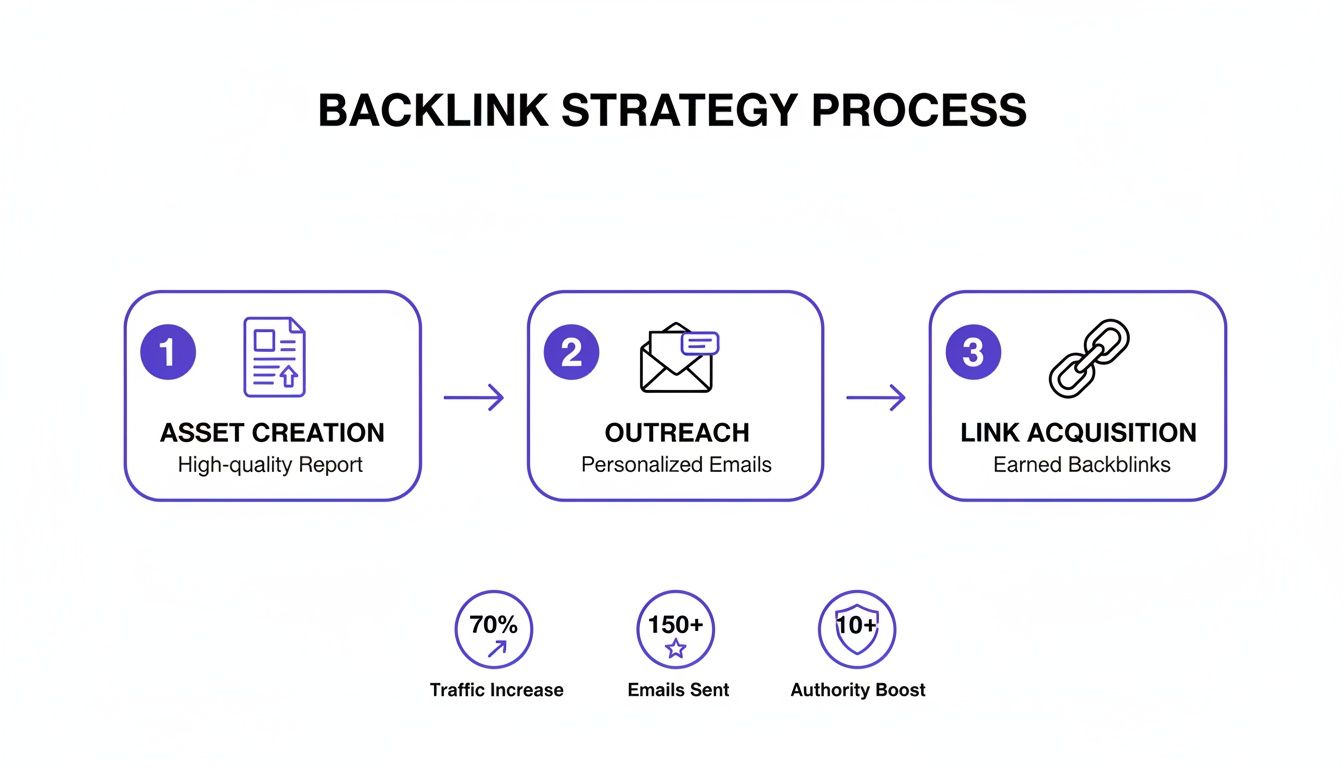
This simple process—creating link-worthy content and then proactively sharing it—is what separates the blogs that grow from the ones that get lost in the noise.
Common Questions I Get About Driving More Blog Traffic
As you start putting these strategies into action, questions are going to come up. That’s totally normal. Getting a handle on the realities of blog growth helps you set the right expectations and, more importantly, stay motivated for the long haul.
Here are the answers to a couple of the most common questions I hear from founders.
How Long Until I Actually See SEO Results?
Ah, the million-dollar question. The honest answer? It depends.
Generally, you can expect to see the first real signs of life from your SEO efforts within 3 to 6 months. If you're starting with a brand-new blog, it’s probably going to be closer to that six-month mark while Google figures out if it can trust you.
But if you're consistently publishing high-quality, keyword-focused content and landing a few backlinks, you'll start to see that slow, steady climb. Remember, SEO is a marathon, not a sprint. The work you put in today will compound and keep paying you back for years.
Look, don't get discouraged if you don't see a huge traffic spike after your first month. Just focus on executing the plan—nailing the SEO foundation, creating strategic content, and getting it out there. The results will come. Consistency is your secret weapon.
What’s the “Right” Publishing Frequency?
The best publishing cadence is whatever you can maintain consistently without letting quality slip. I mean it. Publishing one fantastic, well-promoted article a week is miles more effective than churning out three mediocre ones. Consistency tells both search engines and your audience that you’re reliable.
And when you use platforms like LinkedIn to push that content out, the format and timing are everything. For example, did you know that carousel-style posts get a wild 596% more engagement than plain text updates? That's a real statistic. You can dig into the full research on LinkedIn content performance to get even more specific.
For most founders I work with, aiming for one to two in-depth posts a week is the sweet spot. It gives you enough time to do proper research, write something truly valuable, and—most importantly—actually promote it.