
Growing your business online isn't about throwing spaghetti at the wall to see what sticks. It starts with a clear, actionable plan—not just vague hopes. It's about getting crystal clear on what success actually looks like for you and deeply understanding the world your ideal customer lives in.
This foundational blueprint is what makes sure every single thing you do is laser-focused and, more importantly, effective.
Your Blueprint for Sustainable Online Growth
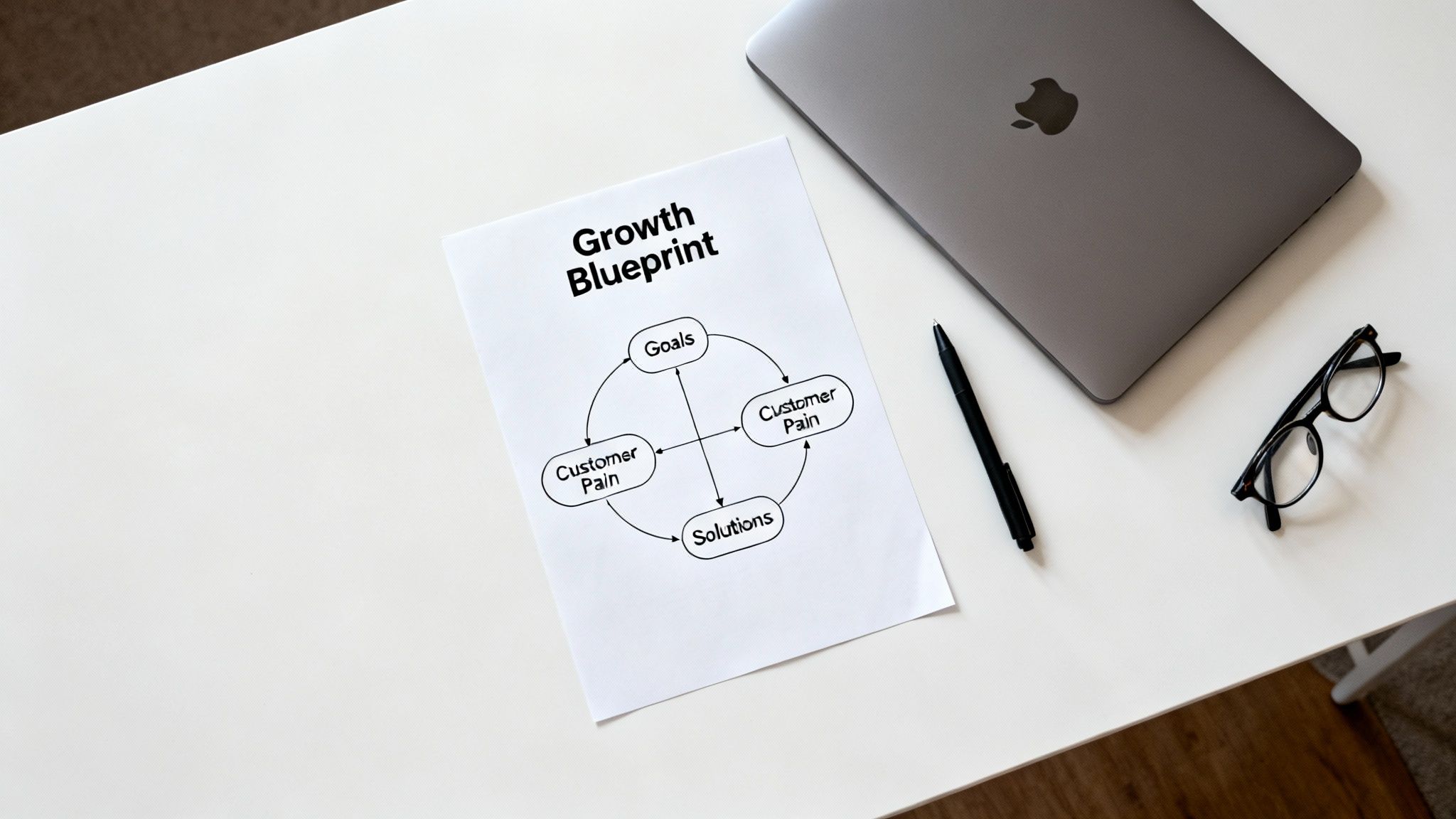
Before you even think about tactics and channels, you need a map. Without one, you’re just wandering in the digital wilderness, hoping to stumble upon customers. This blueprint is your strategic map, and it's built on two core pillars: defining your goals and getting to know your ideal customer on a human level.
Think of it this way: a generic goal like "get more leads" is like saying you want to "travel more." It's meaningless without a destination. A much better goal is specific and measurable, like, "Generate 25 qualified leads per month from LinkedIn within the next quarter."
See the difference? That level of clarity completely transforms your approach. It dictates your content, your channel focus, and how you measure what’s working. It’s the difference between being busy and being productive.
To keep this simple, your entire growth plan rests on these core pillars.
The Core Pillars of Online Business Growth
| Pillar | Focus Area | Key Outcome |
|---|---|---|
| Clear Goals | Defining specific, measurable, achievable, relevant, and time-bound (SMART) objectives. | A clear target that guides all your marketing activities and prevents wasted effort. |
| Audience Empathy | Moving beyond demographics to understand your customer's true pain points, motivations, and daily challenges. | Content and messaging that resonate deeply, building trust and positioning you as the go-to solution. |
Nailing these two areas first is non-negotiable. Everything else we discuss in this guide builds directly on this foundation.
Define Your Version of Success
So, what does growth really look like for your business right now? Vague ambitions lead to scattered efforts and disappointing results. To build a solid foundation, you have to get concrete with measurable objectives.
Here are a few practical examples of what I mean:
- For a B2B Consultant: Increase discovery calls booked through the website by 30% in Q3.
- For a Startup Founder: Grow the email newsletter list to 5,000 engaged contacts by the end of the year.
- For an Agency Owner: Boost brand engagement on LinkedIn by 50% over the next six months to attract higher-value clients.
These goals are specific, time-bound, and tied directly to business outcomes. They give you a clear target to aim for, making it a whole lot easier to build a strategy that actually gets you there. For a deeper look at the big picture, check out these 10 Proven Small Business Growth Strategies.
Identify and Empathize with Your Ideal Customer
Once your goal is set, the next step is to figure out who you're trying to reach. This goes way beyond basic demographics like age or job title. Real customer insight comes from empathy—understanding their daily frustrations, where they hang out online to find solutions, and what truly motivates them.
The key is to map your business solutions directly to your customer's most pressing pain points. If you can articulate their problem better than they can, they will automatically assume you have the solution.
Instead of just knowing their job title, find out:
- What industry podcasts do they listen to on their commute?
- Which online communities or forums do they genuinely trust for advice?
- What's that one annoying task that keeps them working late?
- What internal pressure are they facing from their boss this quarter?
This empathetic approach ensures your content connects on a much deeper level. It’s how you stop being just another voice online and become a trusted, go-to resource. Honestly, this initial blueprint work is the most critical part of the entire journey—it sets the stage for everything that follows.
Choosing Your Stage: Why LinkedIn Is a Powerhouse
When you're trying to grow a business online, it’s easy to get overwhelmed. The default move is to plant a flag on every platform, but that’s a surefire recipe for burnout and mediocre results. Real growth comes from focus. It’s about choosing your stage, owning it, and delivering value where people are actually listening.
For most B2B founders, consultants, and sales leaders, that stage is LinkedIn. Period. This isn't just another social network; it's a professional ecosystem. Business talk isn't just allowed—it's expected. You get a direct line to decision-makers in a place that’s literally built to reward expertise.
The Power of Professional Context
Think about why people open other social apps—usually for entertainment. But on LinkedIn, they’re in a completely different headspace. They’re hunting for industry insights, scouting new opportunities, or looking for solutions to problems they face at work. This environment is exactly where you want to be building authority and finding high-quality leads.
The numbers don't lie. As of 2025, LinkedIn is home to an incredible 1.2 billion members worldwide. It’s not just big; it's effective. A massive 89% of B2B marketers say it generates high-quality leads, blowing other platforms out of the water. We're talking about the quality of the audience and their mindset. You can dig into more of these stats in this insightful LinkedIn statistics from Buffer roundup.
On LinkedIn, your expertise doesn't have to fight for attention against vacation photos or dance challenges. Your expertise is the main event.
Consistency Is Your Growth Multiplier
Showing up is the first step. Showing up consistently is what creates momentum. The LinkedIn algorithm loves regular activity, and for good reason. Think of it like compound interest for your personal brand. Every post you make builds on the last, pushing your reach further and cementing your position as a voice in your space.
The game-changer is this: pages that post just once a week see 5.6x more engagement than those that don’t. That isn’t just a small bump; it’s a blueprint for scaling your online visibility and impact.
Of course, this is where most busy professionals get stuck. Who has the time to constantly come up with new, brilliant things to say? This is precisely why modern workflows are so critical. I've seen firsthand how tools like PostFlow can solve this exact problem. You can capture a thought with a simple voice note, and an AI strategist like Emilia helps polish it into an on-brand post.
Suddenly, what felt like a huge content burden becomes a simple, repeatable system. A consistent weekly posting schedule is no longer a fantasy—it's completely achievable.
Where High-Value Audiences Congregate
To grow your business, you need to be where your ideal clients are. LinkedIn is packed with a concentrated audience of high-income earners and the people who make the final decisions. In fact, 53% of its users come from households earning over $100k annually, and 25% interact with brand content daily.
Your content is landing in front of people who have both the authority and the budget to say "yes" to what you're offering.
- Startup Founders use it to find investors and hire A-players.
- B2B Consultants share their expertise to build trust and land new clients.
- Sales Professionals use it to pinpoint and connect with genuinely qualified prospects.
The platform is designed for these exact interactions. If you want to take it a step further, you can streamline your outreach with proven LinkedIn Prospecting Automation Playbooks to turn those connections into real business opportunities. It’s all about building relationships where they count the most.
Look, choosing LinkedIn isn't about ignoring every other channel forever. It's a strategic move to master the platform where the most valuable conversations in your industry are already happening. Focus your energy here, commit to being consistent, and you'll build a powerful, sustainable engine for growth.
Building Your Content Engine From Idea to Impact
Content is the fuel that powers your entire online growth machine. But let’s be real—for most busy founders and consultants, the actual creation process is the biggest bottleneck. Staring at a blank page is often enough to kill even the best intentions for posting consistently.
The secret isn’t more hustle; it’s a smarter, repeatable workflow. Forget blocking out hours to painstakingly write from scratch. Imagine a system where you can capture raw ideas effortlessly, use smart tools to give them structure, and then quickly polish them into high-impact posts. This is how you actually grow your business online without burning out.
From Voice Note to Published Post
The hardest part of creating content isn't the writing. It's getting the initial thought out of your head and onto the page. This is where a voice-first approach completely changes the game.
Think about it: you're an expert in your field. You talk about your industry, clients, and solutions all day long. Capturing those thoughts as they happen is the most natural way to create authentic content.
Here’s what this modern workflow looks like in practice:
- Capture the Idea: Use a voice recorder on your phone or a tool like PostFlow whenever an idea strikes—on a walk, after a client call, or during your commute. Just talk. Don't worry about structure or polish.
- Generate a Draft: Let an AI assistant, like PostFlow's Emilia, transcribe your recording and whip it into a structured LinkedIn post. The AI acts as your personal strategist, organizing your raw thoughts into a coherent narrative.
- Refine and Schedule: With the heavy lifting done, all you have to do is make a few final edits to make sure the post perfectly captures your voice. Then, schedule it to go live.
This system removes that initial friction, turning a dreaded task into a simple, repeatable habit. Suddenly, consistency isn't just possible—it's easy.
Building Authority with Content Pillars
Trying to be an expert on everything is a fast track to exhaustion and ineffectiveness. Instead, anchor your content around three to five core "content pillars." These are the foundational topics that directly tie into your expertise and the problems your ideal customer is trying to solve.
For example, a marketing consultant for SaaS startups might build their strategy on these pillars:
- Product-Led Growth Strategies
- B2B Lead Generation
- Content Repurposing Tactics
- Early-Stage Startup Scaling
When you consistently create content around these pillars, you build serious topical authority. Your audience knows exactly what to expect from you, and you become the go-to person for those specific subjects. If you're just getting started, our guide on content marketing for beginners is a great place to define these pillars.
Your content pillars are the guardrails for your expertise. They keep your message focused, build deep authority in your niche, and prevent you from running out of relevant ideas.
This simple flow for LinkedIn really drives the point home—it all comes down to focus, consistency, and smart automation.
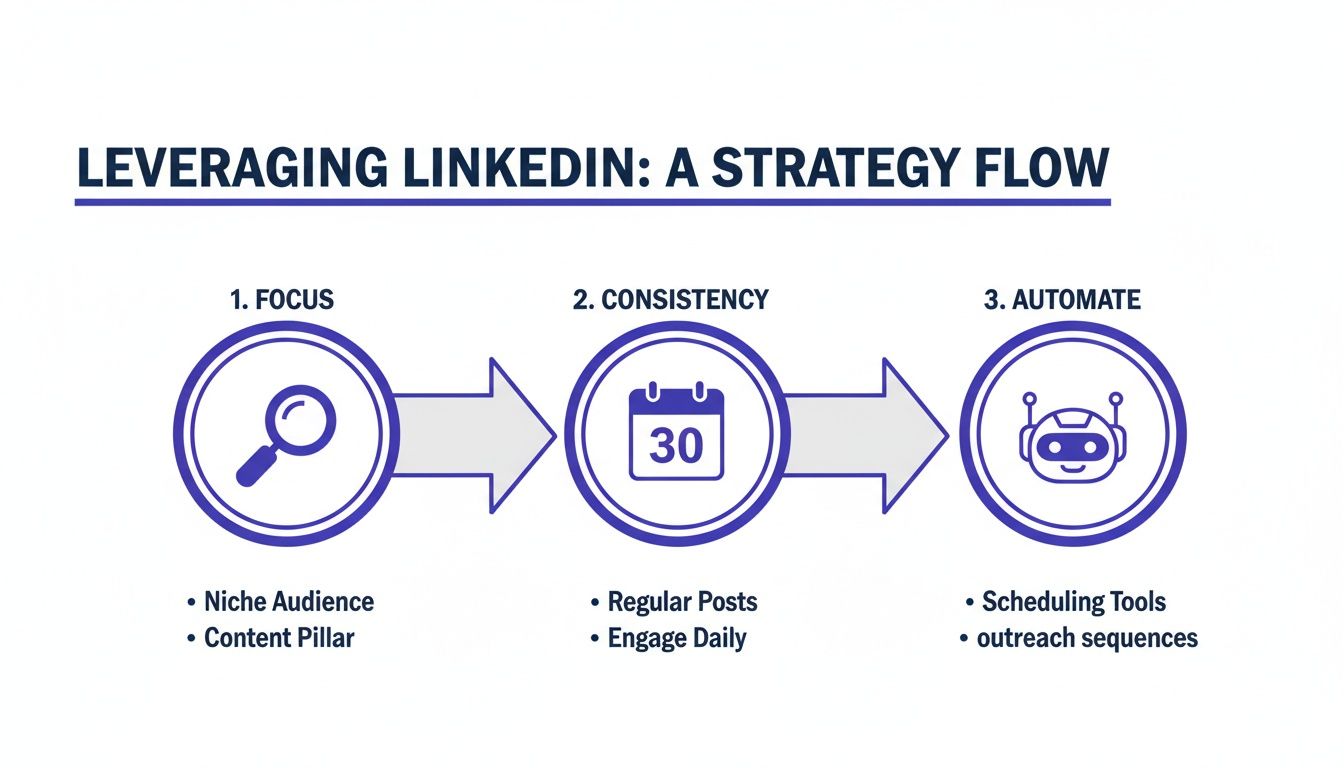
The takeaway here is that a winning strategy moves from a narrow focus to consistent execution, and then you scale it all through intelligent automation—a perfect parallel to an efficient content engine.
The Undeniable Power of Short-Form Video
While text is your foundation, video is the rocket fuel for engagement right now. Video content is exploding on LinkedIn, with uploads jumping 34% year-over-year in 2025 and videos becoming the most shared format on the platform.
Short clips are seeing an incredible 5.6% engagement rate, making them pure gold for consultants and creators. And with LinkedIn ads from video exposure boosting purchase intent by 33%, it's clear that video is no longer a "nice-to-have."
But creating video doesn't have to be a whole production. You can simply repurpose ideas from your content pillars. That successful text post you wrote last week? It can easily become the script for a quick, 60-second video where you talk directly to the camera, sharing the same core insights.
This approach—repurposing ideas across formats, from voice note to text post to short video—is the secret to maximizing your impact without multiplying your workload. It’s a smart system that builds your authority, engages your audience, and ultimately drives tangible business growth.
Turning Attention into Action with a Simple Funnel
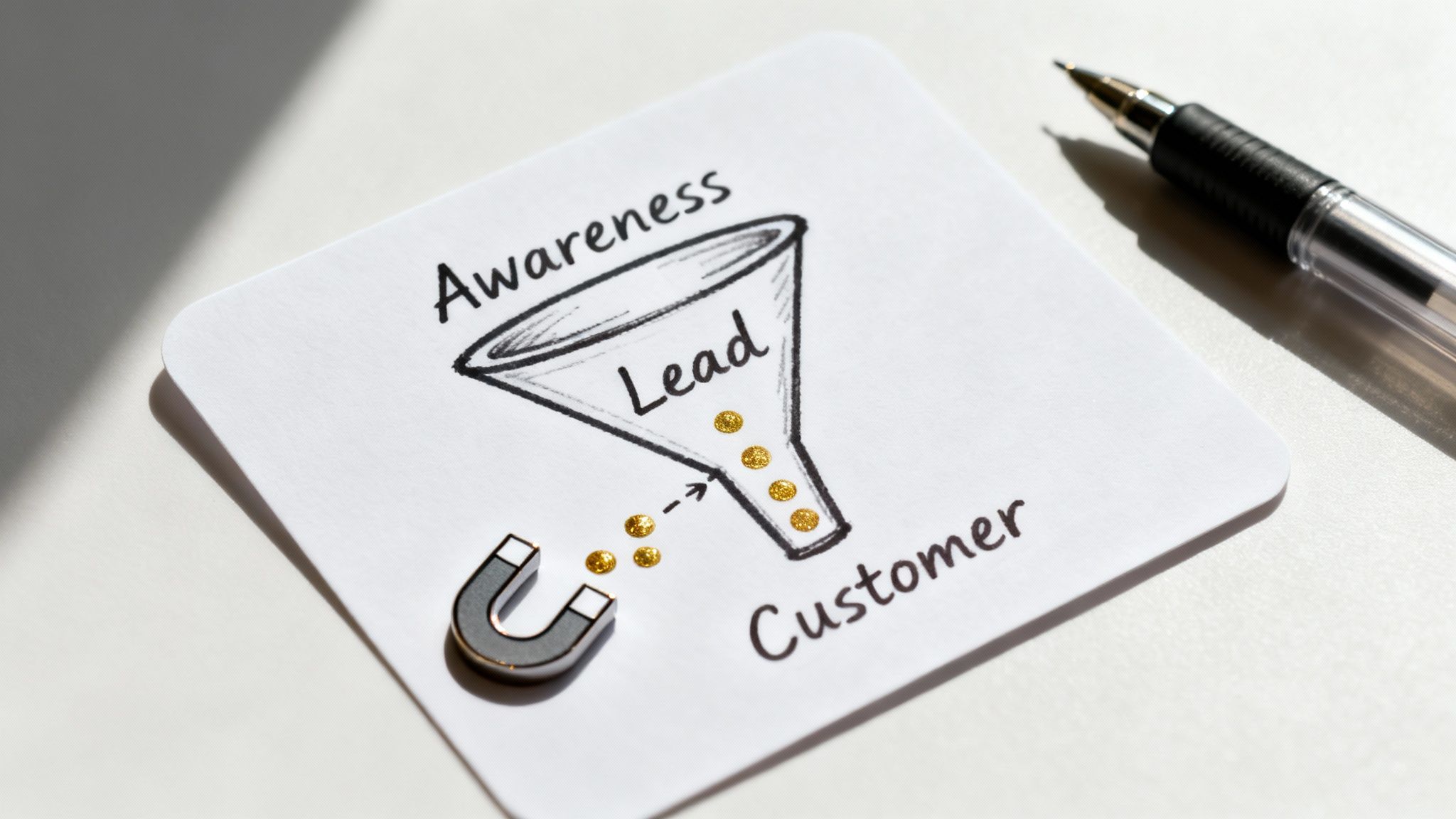
Likes and comments are nice, but they don't pay the bills. The real trick to growing your business online is converting that attention into actual business. This is where a simple conversion funnel comes in—it’s just a clear path you create to guide someone from being a casual follower to a paying customer.
It doesn’t have to be some complex, multi-layered beast. In fact, the best funnels I've seen are built on simple, low-friction steps that build trust and show you know your stuff. It all starts with a fair trade: their email address for something you provide that's genuinely useful.
Create Your Irresistible Lead Magnet
Your lead magnet is basically your digital handshake. It’s a valuable piece of content you offer for free in exchange for an email, moving the conversation from a public feed to their private inbox. This is the very top of your funnel, where you start turning passive scrollers into active leads.
The whole point is to offer something that solves one specific, nagging problem for your ideal customer. It should give them a quick win and a taste of your expertise.
Here are a few ideas that flat-out work:
- A Detailed Checklist: "The 10-Point Pre-Launch Checklist for SaaS Founders" is something someone can use right now.
- An Exclusive Case Study: "How We Doubled a Client's Organic Leads in 90 Days" is pure, powerful social proof.
- A Practical Template: A downloadable "Content Calendar Template for B2B Consultants" saves people time, which is always a winner.
- A Short Video Workshop: A quick 15-minute training on a specific tactic can deliver a ton of value without a huge time commitment.
Your LinkedIn content is the perfect launchpad for your lead magnet. A post that pinpoints a common frustration can then point directly to your checklist or case study as the solution, seamlessly pulling new people into your funnel.
Nurture Relationships with a Simple Email Sequence
Once someone grabs your lead magnet, the real relationship-building begins. You now have permission to talk to them directly. The next move is to build on that initial trust with a simple, automated email sequence that shows you understand their world.
Don't overthink this. A simple three-to-five-part email sequence is all you need to welcome new subscribers, provide more value, and introduce your core offer. The goal is to nurture, not to hard-sell.
Your sequence could look something like this:
- Instant Delivery & Welcome: The first email gets them the goods and offers a warm welcome. Keep it short, sweet, and friendly.
- Share a Related Insight: A few days later, send an email that builds on the topic of your lead magnet. Maybe share a personal story or a common mistake to avoid.
- Introduce Your Solution: In the last email, you can gently pivot to your paid offer. Explain how it solves the bigger problem that your freebie only hinted at.
This step-by-step approach warms people up, making them much more open to hearing about your offer when the time is right. For a deeper dive, our guide on how to generate leads on LinkedIn has strategies that tie into this perfectly.
Present a Clear and Compelling Offer
The final piece of the puzzle is a clear, irresistible offer. After you've spent time delivering value and building trust, your audience is ready to hear how you can help them more deeply. This is where all that consistent content marketing pays off.
For anyone in the B2B space, LinkedIn is a powerhouse for this. An incredible 89% of marketers get high-quality leads from the platform, and 97% use it for content marketing. Ads here can deliver a 2-5x return on ad spend and create 33% higher purchase intent. The data is pretty clear.
Your content has already done the heavy lifting by positioning you as an authority. Now, your offer—whether it's a discovery call, a paid consult, or a signature course—feels like the logical next step. This entire flow is how you systematically turn audience attention into real, measurable growth for your business.
Measuring What Matters for Agile Growth
So, you’re posting content and you’ve built a funnel. That’s a huge win, but it’s only half the battle. If you’re not measuring what’s working (and what isn’t), you’re essentially flying blind. I see so many entrepreneurs get stuck here, either drowning in a sea of data or chasing numbers that don’t actually move the needle on their business.
The key to real, sustainable growth online is to get agile. It’s a simple but incredibly powerful loop: test, measure, learn, and adapt. Forget rigid, year-long plans. Instead, you operate in short sprints, making smart, data-informed tweaks along the way. This turns your strategy from a static document into a living system that gets smarter every single month.
Ditching Vanity for Value
First things first: we have to stop obsessing over vanity metrics. Sure, big follower counts and viral-level impressions feel good, but they don’t pay the bills. A post with 100,000 views that brings in zero leads is infinitely less valuable than one with 1,000 views that lands you two high-quality clients.
To really understand your momentum, you need to focus on Key Performance Indicators (KPIs) that signal genuine progress.
These are the metrics that actually matter:
- Lead Quality: Are the people grabbing your lead magnet the ones you actually want to work with?
- Conversion Rates: What percentage of people hitting your landing page sign up? How many of those email subscribers end up booking a call?
- Engagement on High-Value Content: Which topics or post formats are driving the most profile visits, thoughtful comments, and DMs?
Tracking these KPIs tells a much richer story. They show you not just what is happening, but why it’s happening.
Building Your Monthly Review Framework
Data is completely useless without a system for making sense of it. A simple monthly review is all it takes to create a powerful feedback loop. Seriously, just block out an hour at the end of each month to look at the numbers and ask the right questions.
You can pull this data straight from your platform analytics, or use a streamlined dashboard in a tool like PostFlow to see it all in one place. The goal isn’t just to look at charts; it's to find patterns and pull out actionable insights.
Here’s a quick rundown of what to look for:
- Top-Performing Content: Pinpoint the 2-3 posts that got the most meaningful engagement. Was it a video? A personal story? A step-by-step guide? Whatever it was, do more of that next month.
- Lead Generation Sources: Where did your best leads come from? Was it that one specific LinkedIn post that sent a flood of traffic to your lead magnet, or was it the link in your email signature? Find the source and lean into it.
- Funnel Drop-Off Points: Take a hard look at your conversion rates. If a ton of people download your checklist but almost no one opens the follow-up emails, you’ve got a problem—likely with your subject lines or the content of the emails themselves.
This whole process isn't about judging your performance; it's about learning. For a deeper dive, exploring different social media engagement metrics can help you fine-tune exactly what you’re tracking.
An agile growth strategy isn't about getting everything right the first time. It's about being willing to test, fail, learn, and pivot quickly based on real-world data.
This constant cycle of refinement is what separates the businesses that thrive online from those that just spin their wheels. It gives you permission to stop wasting time on tactics that don’t deliver and pour that energy back into the activities proven to work for your audience. Over time, these small, consistent adjustments compound into massive growth.
A Few Common Questions I Get Asked About Growing Online
When you're starting to build your presence online, it’s natural to have questions. Everyone does. I’ve put together some straight-talk answers to the most common ones I hear from entrepreneurs, hopefully clearing the path so you can move forward with confidence.
How Long Does This Actually Take?
Look, growing a business online is a marathon, not a sprint. Anyone telling you otherwise is selling something. While you can definitely get a quick hit of traffic with paid ads, building a real, organic presence that pulls in the right kind of clients just takes time.
For most people I work with who are committed to a content-first approach, you'll start to feel some real traction within three to six months. This is when you'll see things like more profile views, better engagement on your posts, and a noticeable uptick in website visits. Think of this as your warm-up lap—you're building momentum and finding your voice.
The real magic, that predictable flow of good leads, usually kicks in after the six to twelve-month mark. By then, your consistency has built a foundation of trust. People know who you are and what you stand for, making it way easier to attract and convert them.
The single most important thing? Consistency. I can't stress this enough. Posting valuable content every single week builds momentum that compounds on itself. If you can commit to a solid six-month strategy, you’re setting yourself up for real, lasting results.
What’s the Biggest Mistake People Make?
Easy. A total lack of focus. So many entrepreneurs fall into the trap of trying to be everywhere at once. They're on every social media platform, trying every new content format, and just spreading themselves way too thin.
This "spray and pray" method is a surefire recipe for burnout, and you'll have very little to show for all that effort. It's the classic case of being a jack of all trades and a master of absolutely none.
The smarter play? Master one, maybe two, channels where you know your ideal audience hangs out. For most B2B folks, that’s LinkedIn. So go deep there.
- Learn its quirks: Figure out what kind of content the algorithm loves and what your audience actually responds to.
- Create for the platform: Tailor your message and style for a professional crowd. What works on TikTok won't work here.
- Show up for real: Don't just post and ghost. Join conversations, build actual relationships, and give value without asking for anything in return.
Once you’ve got a repeatable system that brings in results on that main channel, then you can think about expanding. Focus first, scale later.
Do I Need a Ton of Money to Do This?
Nope. You absolutely don't need a huge budget to see serious growth. But you do need to be ready to invest one of two things: your time or your money.
You can get incredible results with a purely organic, "time-first" strategy. This whole approach is built on creating genuinely helpful content, engaging with your community, and building real relationships. It's powerful for creating a loyal following and serious brand authority, but it demands your time and consistency.
On the flip side, a "money-first" strategy uses paid ads to blast your message out to a bigger audience, fast. It can be a great way to scale quickly, but you need to know what you're doing with ad platforms and have the budget to back it up.
For most businesses, a hybrid model works best:
- Start with Time: Invest your time in organic growth first. Build that solid foundation and figure out what messaging actually works.
- Reinvest with Money: Once you have a proven system, you can start strategically putting profits back into paid ads to amplify what’s already working.
This way, you build a sustainable growth engine without needing a massive pile of cash upfront.
Ready to stop guessing and start posting with a purpose on LinkedIn? PostFlow is your AI content strategist, designed to turn your quick voice notes into polished, on-brand posts. Let Emilia, your personal AI strategist, help you transform your expertise into content that actually grows your business.