
So, you want to get more coaching clients. It's the million-dollar question, isn't it? The good news is that it’s less about chasing every lead and more about building a solid foundation that pulls the right people in.
This isn't just theory. This is a practical playbook for building a client pipeline that doesn't dry up. We'll walk through the essential pillars: defining your niche, creating an irresistible offer, mastering organic marketing, and finally, scaling with proven systems. It’s all about creating genuine connections and delivering real value.
And you’ve picked a great time to be in this business. The global coaching industry was valued at around $6.25 billion and is on track to hit $7.30 billion by 2025. The profession has more than doubled since 2019, which tells you one thing: demand is massive and growing for coaches who get results.
Think of the process in three core stages.
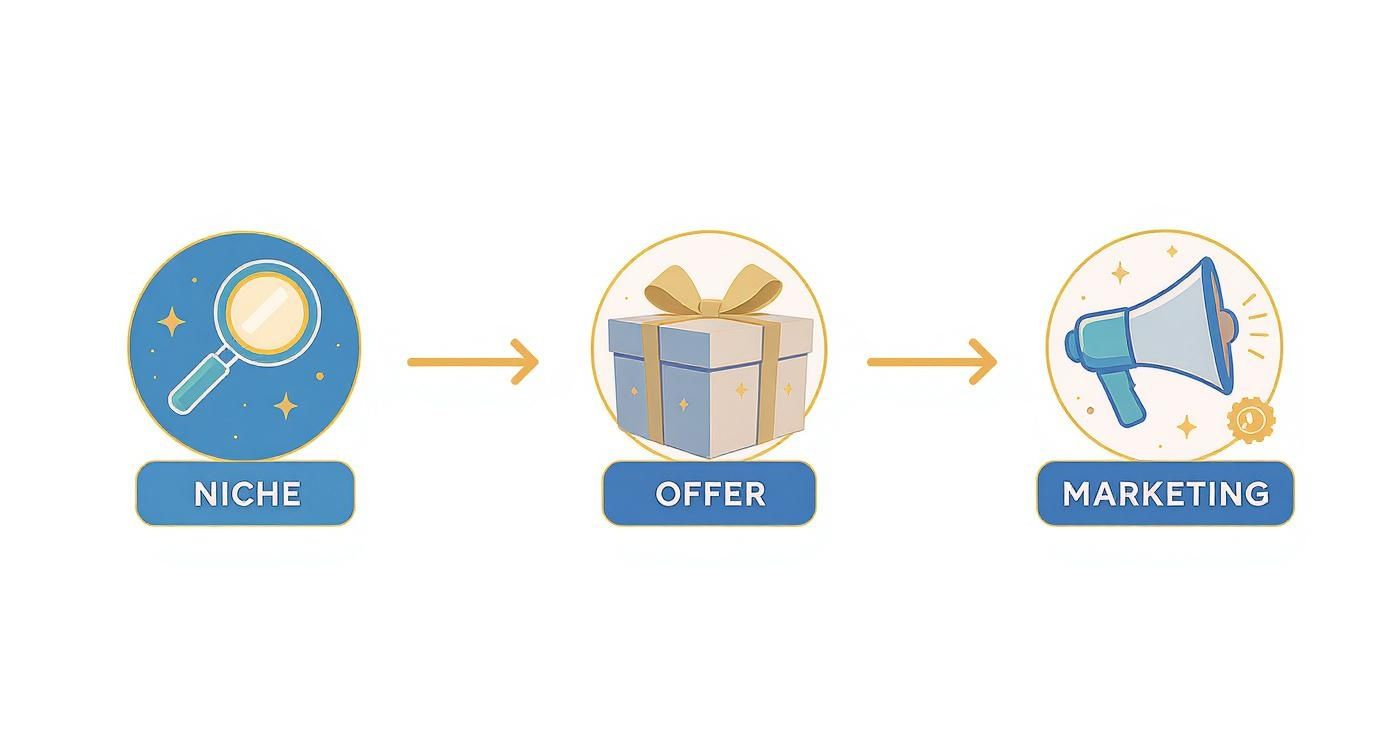
Each step builds on the last. Get your niche right, and your offer becomes clearer. Nail the offer, and your marketing practically writes itself. It’s a clean, logical flow.
Before we dive deep into each component, let's look at the big picture. I've broken down the client acquisition journey into four core pillars. Mastering each one is what separates the struggling coaches from the ones with a waitlist.
The Four Pillars of Coaching Client Acquisition
| Pillar | Objective | Key Activities | Success Metric |
|---|---|---|---|
| Foundation | Define who you serve and the specific problem you solve. | Niche selection, Ideal Client Persona (ICP) development. | Crystal-clear messaging that resonates with a specific audience. |
| Offer | Create a high-value coaching package that delivers a clear transformation. | Program design, pricing strategy, crafting compelling offer details. | High conversion rate from discovery calls to signed clients. |
| Marketing | Attract and engage your ideal clients consistently. | Content creation (LinkedIn, etc.), organic outreach, building relationships. | A steady stream of qualified leads and discovery call bookings. |
| Sales & Systems | Convert leads into paying clients and streamline the entire process. | Sales call scripting, onboarding workflows, KPI tracking, funnel optimization. | Predictable monthly revenue and client growth. |
Getting these four pillars right is what creates a sustainable, thriving coaching business.
Why This Foundational Approach Works
Starting with a strong base is the only way to escape the feast-or-famine cycle that plagues so many new coaches. When you’re crystal clear on who you serve and what you offer, your marketing stops being a shot in the dark. You’re no longer shouting into the void; you're starting meaningful conversations with people who are actively looking for your help.
This isn’t just a coaching thing, either. It’s a universal principle for any service-based business. In fact, many of the same ideas apply to other independent professionals, which we cover in our guide on how to get freelance clients. The core challenge is always the same: attracting the right people.
The key takeaway is this: sustainable client acquisition is a system, not a series of random tactics. By focusing on your niche, offer, and marketing in that order, you create a powerful attraction engine for your coaching business.
This systematic approach gives you a clear path forward. It helps you cut through the noise, avoid the overwhelm, and put your energy where it matters most—on the activities that will actually land you more coaching clients.
Figure Out Your Niche and Build an Offer They Can’t Ignore
Let's get one thing straight: trying to be a coach for everyone is the fastest way to get clients for no one. I’ve seen it happen time and time again. Before you can build a steady stream of clients you love working with, you have to get brutally honest about who you are, who you serve, and the specific change you bring to their lives. This clarity is the foundation for everything else you'll do.
So many coaches get nervous about niching down. They worry they're cutting off potential clients. But the reality is the complete opposite. When you have a sharp, well-defined niche, you become the only logical choice for a very specific group of people who have a very specific, urgent problem. You stop being a generalist and become a specialist—and specialists get to charge more and have way more authority.
Finding Your Sweet Spot Niche
Your perfect niche isn't something you just invent. It’s found where three things overlap. Picture a Venn diagram.
- Your Expertise & Lived Experience: What problems have you already solved, either for yourself or for other people? What unique skills, knowledge, or personal journey gives you an edge? This is where your real authority comes from.
- Your Passion & Genuine Interest: What do you actually enjoy talking about? Coaching takes a ton of energy, and you'll burn out fast if you're not genuinely invested in the people and problems you're working on.
- Real Market Demand: Are people out there actively looking for a solution to this problem? Crucially, are they willing to pay to fix it? A passion is just a hobby until you find a market for it.
Think about it this way: a former corporate manager who clawed her way back from burnout could specialize in coaching mid-level execs on how to get their work-life balance back. That’s so much more compelling than just being another generic "life coach."
Build Your Ideal Client Avatar
Once you’ve got your niche, you need to zoom in even further and create an Ideal Client Avatar (ICA). This is basically a detailed profile of the one person you are perfectly built to help. Give this person a name, a backstory, make them real. It sounds a little silly, but it’s a game-changer for writing marketing that actually connects.
Don't just stick to the basic demographics. The real gold is in their psychographics—what’s going on inside their head.
- What are their biggest daily frustrations and pain points? (e.g., "I feel like I’m drowning, constantly overwhelmed and failing both at work and at home.")
- What are their secret hopes and deepest desires? (e.g., "I just want to kill it in my career without feeling like I'm missing my kids grow up.")
- What specific words do they use to talk about their problems? (e.g., They’d probably say "I'm stuck in the weeds" not "I need to improve my strategic focus.")
- Where are they already hanging out online? (Specific LinkedIn groups for their industry? Certain subreddits? Following particular influencers?)
Knowing this stuff lets you create content and messaging that makes your ideal client stop scrolling and think, "Wow, it’s like they're reading my mind."
Craft an Offer That's a No-Brainer
Okay, with a clear niche and a vivid ICA, you can finally build a coaching offer that feels like the exact answer they’ve been desperately searching for. A weak offer talks about features, like "12 one-hour calls." A powerful, irresistible offer sells the transformation.
Your offer isn't about selling your time; it's about selling a result. People don't buy coaching calls—they buy a future version of themselves.
Package your coaching as a complete solution. This instantly positions you as an expert with a proven system, not just some person who rents out their time by the hour.
Here’s a simple way to structure a high-value offer that sells itself:
- Give It a Punchy Name: Ditch "3-Month Coaching Package." Try something like "The Executive Accelerator" or "The Burnout to Balance Blueprint." It sounds like a real program.
- Define the Tangible Outcome: Get specific. What's the result they'll walk away with? "Double your sales pipeline in 90 days" is infinitely better than "get better at sales."
- Outline Your Signature Process: Break the journey down into a few key milestones or pillars. For example: "Pillar 1: Get Total Clarity on Your Vision," "Pillar 2: Master Your Time & Energy," "Pillar 3: Lead with Real Influence."
- List the Deliverables: Now you can list the features that make it happen.
- 12 weekly 1-on-1 strategy sessions
- Unlimited support via Email & Voxer between calls
- Private access to a resource hub with all my templates & worksheets
- A final 90-day action plan to keep the momentum going
This structure shifts the conversation away from the cost of your time and toward the massive value of the outcome. Your price becomes an investment in their future, not an expense. Nailing this foundation is absolutely critical if you want to learn how to get coaching clients consistently.
Master Organic Marketing to Attract Ideal Clients
You've got a powerful offer. That's a huge step. But getting it in front of the right people? That's where the real work begins. Forget dumping money into ads right away. Your quickest path to a steady stream of clients is mastering organic marketing, and for most coaches, there's no better playground than LinkedIn.

This isn't about spamming your connections or dropping generic hustle quotes every morning. It's about building a strategic system—turning your profile into a client magnet and using real, valuable content to build relationships that convert.
Turn Your LinkedIn Profile into a Sales Page
Think of your LinkedIn profile as the front door to your coaching business, not a dusty old resume. The second a potential client lands there, it needs to scream two things: "Who do you help?" and "What problem do you solve for them?"
Start with your headline. "Leadership Coach at XYZ Coaching" is boring and says nothing. Flip it to be benefit-driven. Something like, "Executive Coach Helping New Managers Lead with Confidence & Avoid Burnout" instantly tells your ideal client they're in the right place. It speaks directly to their pain.
Your "About" section is next. It's your chance to tell a story.
- The Hook: Kick things off with a question or a bold statement that makes your ideal client nod and say, "That's me."
- The Problem: Dive deep into the frustrations and struggles they're dealing with right now. Show them you get it.
- The Solution: This is where you position your coaching as the bridge from their current headache to their dream outcome.
- The Call to Action: Don't leave them hanging. End with a clear next step. "Shoot me a DM to talk about..." or "Book a free clarity call here."
Just these few tweaks can transform your profile from a passive CV into an active, lead-generating machine.
Create Content That Attracts and Converts
Content is how you build authority and get leads coming to you. The goal isn't to go viral; it's to make your ideal client feel seen, understood, and absolutely certain you're the one who can help them.
Your content should do the heavy lifting of your sales process. By the time someone gets on a call with you, they should already be 80% sold because your posts have demonstrated your expertise and built trust.
Here are three simple post formulas you can start using today:
- Problem-Agitate-Solve: Name a specific problem your client has. Pour a little salt in the wound by describing why it's so frustrating. Then, offer a practical tip or a mindset shift to solve it, proving your value on the spot.
- Client Story: Share a (permissioned and anonymous) success story. Talk about where they started, the specific challenge you helped them overcome, and the amazing result they got. Nothing sells like social proof.
- Contrarian View: Take a common piece of advice in your niche and challenge it. Explain why you disagree and offer a smarter alternative. This positions you as a genuine thought leader, not just another echo.
If you want to go deeper on content, our guide on how to generate leads on LinkedIn is packed with more advanced strategies.
Master the Art of Authentic Outreach
Content brings people in, but smart outreach closes the deal. The key is to make every interaction about them, not you. Forget spammy, copy-paste messages.
First, use LinkedIn's search filters to find people who fit your ideal client profile—think industry, job title, and location. You can also explore dedicated sales prospecting tools to make this process much faster and more efficient.
Once you have a list of prospects, it's time to connect with a simple sequence:
- The Connection Request: Personalize it. Always. Mention a post they wrote, a shared connection, or something from their profile. "Hi [Name], saw your post on [Topic] and loved your point about X. Would be great to connect."
- The Value-First Message (2-3 days later): Once they accept, send something helpful with zero strings attached. "Great to connect, [Name]. Stumbled on this article about [Relevant Topic] and thought you might find it interesting."
- The Nurture & Pivot Message (a week later): After engaging with their posts for a bit, look for an opening. "Hey [Name], I noticed you're hiring a new sales director. I actually specialize in helping new managers in that role ramp up quickly. If you ever need support in that area, I'd be happy to chat."
This approach builds real rapport and makes the shift to a sales conversation feel natural and earned. It’s this digital connection that's driving massive industry growth—the online coaching market is set to hit $4.5 billion by 2028, all because coaches can now connect with clients anywhere. This is how you get coaching clients in a way that feels good and actually works.
Use Partnerships And Referrals To Get Warm Leads
Don't get me wrong, organic content is a brilliant way to pull in clients. But some of your absolute best leads will never find you through a Google search or their social feed. They'll come from people who already know you and trust your work.
That's the magic of referrals and partnerships—a pipeline of warm leads who are practically sold on you before you even hop on a call.

But you can't just leave these introductions to chance. You need a system. A repeatable process for getting referrals and building strategic alliances is one of the smartest ways to land coaching clients without a massive marketing budget. It’s about tapping into existing networks of trust.
Suddenly, client acquisition stops feeling like a constant hunt for strangers and starts feeling like a natural part of the relationships you're already building.
Set Up A Simple Referral System
Your happiest clients are your best salespeople. Period.
When someone has a genuine breakthrough working with you, they're often excited to tell people in their circle who are dealing with the same stuff. Your job is to make it dead simple for them to do just that.
You don’t need anything complicated. A basic referral program works wonders.
- When to Ask: The best time is right after a big win or when you're wrapping up your work together. Their success is fresh in their mind, and they're feeling great about the investment.
- What to Say: Don't make it weird. Just frame it as a way for them to help people they care about. Something as simple as, "I'm so thrilled with the progress we've made. If you happen to know any other [Job Title] struggling with [Problem], I'd be grateful for an intro," is all it takes.
- Offer a Real Incentive: Sure, some clients will refer you just because they love you. But an incentive sweetens the deal. Think about a gift card, a discount on future coaching, or even a small commission on the new client's package.
The secret is to make it frictionless. Give them a pre-written email or message they can just copy, paste, and send. The less work they have to do, the more likely they are to actually do it.
This simple system turns every happy client into a potential source of new business, creating a powerful feedback loop that fuels your growth.
Find Your Strategic Partners
Okay, beyond your own clients, who else serves your ideal client but isn't your direct competitor? These people are your strategic partners.
Think about it: who are the professionals your clients already trust and happily pay for advice? A partnership here gives you a direct line to a pre-qualified audience that's ready to listen.
Let's say you're a career coach for tech executives. Your ideal partners could be:
- Financial advisors who handle the portfolios of high-earning tech pros.
- Web designers who build personal brand websites for VPs and Directors.
- Headhunters and recruiters who are plugged into the tech scene.
The goal is to find professionals whose services are complementary to yours. You're both solving different problems for the same person, which makes any collaboration a win-win-win for you, your partner, and the client.
To get started, jot down a list of 5-10 types of professionals who could be a good fit. Then, start looking for people on LinkedIn or in your network who fit the description. Your first message shouldn't be a hard pitch; just focus on providing value first. Propose a quick chat to see how you might be able to help each other's clients.
That’s how you get coaching clients through collaboration, not competition.
One-on-one outreach is great, but let's be honest, it's a grind. What if you could get your message in front of dozens of ideal clients at once? Even better, what if you could sign up multiple new clients from a single one-hour session?
That’s exactly what a high-value workshop or webinar can do for you. It's one of the most powerful ways to get coaching clients at scale.
This isn't about giving a stale, boring PowerPoint presentation. The goal is to create a live, interactive experience that delivers real value, builds massive trust, and makes your coaching offer the only logical next step for anyone who's serious about getting results. When you get this right, a workshop becomes the core engine of your client-generating machine.
Choose a Topic That Sells Itself
The success of your workshop lives or dies by its topic. A vague or uninteresting title means an empty virtual room, no matter how brilliant your content is. You have to pick a topic that solves a single, urgent, and super-specific pain point for your ideal client.
Stop thinking about what you want to teach. Start thinking about what problem keeps them up at night. A killer workshop topic feels like an immediate solution they can't afford to miss, not just another piece of "nice-to-have" information.
Here are a few examples of workshop topics that just work:
- For a career coach: "The 5-Step Framework to Ace Your Next Tech Interview (Even If You're an Introvert)"
- For a wellness coach: "Beat the 3 PM Slump: How to Double Your Afternoon Energy Without Caffeine"
- For a business coach: "From Crickets to Clients: Your First 3 Steps to Landing High-Ticket Projects on LinkedIn"
See the pattern? Each one promises a specific outcome and speaks directly to a real, tangible struggle. It’s practical, actionable, and screams value from the get-go.
Structure Your Workshop for Conversions
A workshop that converts isn't just a random brain dump of your best tips. It follows a deliberate structure, a psychological journey designed to take attendees from curious lurkers to committed clients. Your job is to give them a quick, tangible win while also showing them why they need your help for the bigger picture.
Your workshop needs to be so valuable that people feel like they should have paid for it. When you give that much away for free, the decision to invest in your paid program becomes a no-brainer.
I've seen this proven flow work time and time again:
- The Powerful Hook (First 5 Minutes): Kick things off with a bold promise or a relatable story that grabs their attention instantly. Show them you understand their struggles and promise a clear, valuable outcome by the end of the hour.
- The Core Content (30-40 Minutes): This is where you deliver the goods. Teach your framework, focusing on the "what" and the "why," but hold back on all the nitty-gritty "how." Give them actionable steps they can use right away to get a small victory. This is how you prove your expertise.
- The Seamless Transition (5 Minutes): Now, you bridge the gap between your free content and your paid offer. It can sound as natural as this: "Everything we've covered today is enough to get you started, but to truly master this and see lasting results, you're going to need personalized support and accountability..."
- The Compelling Offer (10-15 Minutes): This is where you clearly present your coaching program as the solution to their bigger problem. Talk about the transformation, not just the features. Lay out the process and what they get. Always add a time-sensitive bonus (like a fast-action discount or an extra 1:1 call) to create urgency and get people to sign up on the spot.
This structure respects everyone's time, over-delivers on value, and makes your pitch feel like a helpful next step instead of an aggressive sales tactic.
And this isn't just a side hustle. As coaches build successful businesses, they naturally expand their services. Industry data shows that 60% of coaches also provide training (like workshops), and 57% offer consulting. You can dig into more coaching statistics at entrepreneurshq.com. This shows just how natural and profitable group formats are for building a sustainable practice beyond 1:1 work.
Lead Sales Calls and Onboard Clients with Confidence
Getting a prospect on a sales call is a huge win. But let's be real—turning that chat into a signed contract is where the magic (and the money) happens. So many coaches I know get nervous about this part, worried they'll sound like a used car salesman.
Here’s a mindset shift: stop thinking of it as a "sales call." It’s a discovery session. A chemistry check. Your only job is to see if you are genuinely the right person to help them solve their problem. This isn't about a hard sell; it’s about having a confident, guided conversation.
When you do it right, you’re not selling at all. You're building trust, digging deep into their challenges, and then simply showing them how your coaching is the most logical path forward. The prospect practically sells themselves.

A Flexible Framework for Sales Calls
First thing's first: throw out any rigid script that makes you sound like a robot. A real conversation needs a flexible framework, not a word-for-word teleprompter. This approach lets you hit all the important notes while still being a real human who can adapt to the person on the other end.
Build Rapport (5-10 minutes): Start with genuine curiosity, not a script. Ask about their day, or better yet, mention something you saw on their LinkedIn profile. The idea is to connect as people before you start talking business. Getting them comfortable and excited from the jump is key. We have a whole guide on 5 proven ways to get prospects excited about your first sales call if you want to go deeper.
Dig for the Pain (15-20 minutes): This is the heart of the call. Your mission is to understand their world. Use open-ended questions like, "What’s the single biggest roadblock you're hitting right now?" or "If we were talking six months from today, what would have to have happened for you to feel like this was a massive success?" Then, shut up and listen. Seriously. Listen more than you talk.
Connect the Dots (10-15 minutes): Once you have a crystal-clear picture of their problem, it's time to connect it directly to your solution. Frame your coaching program as the bridge that takes them from where they are now (frustrated, stuck) to where they want to be (that success they just described).
Handle Objections & Close (5-10 minutes): Objections are normal; don't fear them. When someone says, "I can't afford it," meet them with empathy. A great response is, "I completely understand it's a significant investment. Let's break down the potential return you'd see from achieving [their specific goal]."
Think of the sales call as the final diagnostic step. You're simply helping the prospect get clarity on their problem and showing them a clear path forward—a path that happens to be your coaching program.
Creating a Seamless Onboarding Experience
The moment a client says "yes" is just the beginning. A sloppy, confusing onboarding process can instantly trigger buyer's remorse. On the other hand, a smooth, professional welcome makes them feel brilliant for choosing you and gets them excited to start.
Your onboarding needs to be a well-oiled machine that takes care of the admin so you can focus on what you do best: coaching. To really nail this, I highly recommend digging into these customer onboarding best practices.
A killer onboarding flow usually includes these four things:
- A Welcome Packet: Don't just send a boring email. Create a sharp, well-designed PDF that congratulates them, outlines what to expect, and tells them exactly what the next steps are.
- Contract and Invoice: Get the paperwork out of the way fast. Use a professional tool to send the agreement and the first invoice right away. No delays.
- Intake Questionnaire: Before your first call, have them fill out a detailed form about their goals, history, and biggest challenges. This saves a ton of time and shows you mean business.
- Scheduling the Kickoff: Make it dead simple for them to book that first powerful session with you.
This kind of structured start ensures nothing gets missed. It makes every new client feel seen, valued, and totally confident they made the right call hiring you.
Common Questions About Getting Coaching Clients
Once you decide to become a coach, the questions start popping up. Fast. And they're usually not the big-picture, "what's my legacy?" kind of questions. They're the practical, in-the-trenches queries that can either stall you out or propel you forward.
Let's cut through the noise and tackle the real questions I hear from coaches every single day. Getting clear on these points is the difference between spinning your wheels and building a client roster with confidence.
How Many Coaching Clients Do I Need?
Honestly, this question is a trap. Chasing a specific number of clients—say, 10 or 20—is vanity. The real metric you should be focused on is your income goal.
It’s far more powerful to work backward. Let's say your target is $10,000 per month. How could you get there?
- 10 clients paying $1,000 each.
- 5 clients in a group program at $2,000.
- Just 2 high-ticket clients at $5,000 a pop.
See the difference? When you start with your financial target, you gain instant clarity on how to structure your offers. This lets you build a business model that actually fits your life, not the other way around.
What Is the Fastest Way to Get My First Client?
Forget complex funnels and cold outreach for a minute. The absolute quickest path to your first paying client is almost always sitting right in your existing network.
The people who already know you, like you, and trust you are your low-hanging fruit. Think about it: friends, family, ex-colleagues. These aren't people you need to "sell" to in a sleazy way. You just need to let them know what you're doing now and who you're helping.
A warm introduction or a referral from someone in your circle is gold. It cuts through all the noise and puts you in front of someone who is already primed to listen.
Should I Offer Free Coaching Sessions?
Yes, but you have to be smart about it. The free "discovery call" or "clarity session" is an industry staple for one simple reason: it works. But there's a huge pitfall here—giving away so much value for free that they have no reason to hire you.
A 30 to 45-minute call is the sweet spot. It's just enough time to dig into a pain point, offer a genuine insight, and show them what's possible, but it's not long enough to solve their whole problem for them.
Think of the free session as a powerful sales tool, not a charity service. Your goal is to give them a taste of the transformation, leaving them wanting the full meal.
How Do I Stand Out in a Crowded Market?
Here's the secret: stop trying to be everything to everyone. The biggest mistake I see new coaches make is casting their net too wide. Being a general "life coach" or "business coach" makes you a commodity, and when you're a commodity, you have to compete on price. It's a race to the bottom.
Specialization is your superpower.
Instead of being a generic coach, become "the confidence coach for new female managers in the tech industry." A laser-focused niche like that does three things immediately: it makes your marketing a million times easier, it basically eliminates your competition, and it gives you the authority to charge premium rates.
When you're the only solution to a very specific problem, clients don't just want to work with you—they need to. That's how you get coaching clients who are thrilled to pay for your expertise.
At PostFlow, we know that showing up consistently with high-value content is the bedrock of attracting your ideal clients. Let our AI content strategist, Emilia, help you transform your expertise into magnetic LinkedIn posts that build your authority and fill your pipeline.
Stop stressing about what to post and start connecting with the clients you're meant to serve. Get started at https://gopostflow.com.