A digital content strategy is basically the blueprint for your professional reputation, especially on a platform like LinkedIn. It’s what turns random, hopeful posting into a structured plan where every single piece of content you share is intentionally building toward a specific business goal.
Without this blueprint, you're just guessing. With one, you're building an asset.
Why a Digital Content Strategy is a Game-Changer on LinkedIn
Imagine trying to build a house without a blueprint. You could have the best bricks and the finest wood, but without a plan, you’re just stacking them randomly and hoping a house magically appears. That’s exactly what happens when you post on LinkedIn without a clear strategy.
Your content, no matter how insightful, ends up as a collection of disconnected thoughts. It fails to tell a cohesive story that builds your authority. A solid content strategy provides the framework that turns your expertise from a hobby into a powerful business driver. It’s the difference between being a passive observer and an active architect of your professional brand.
From Daily Chore to Strategic Asset
I’ve talked to countless founders, consultants, and creators who feel like content creation is a relentless, soul-sucking chore. A well-defined strategy completely flips that script.
It gives you a repeatable system that kills the daily guesswork of "what should I post today?" Instead of staring at a blank screen, you have a clear roadmap guiding your efforts. This plan is built on a few core pillars:
- Audience Understanding: Getting crystal clear on the specific problems your ideal clients are losing sleep over.
- Expert Positioning: Framing your knowledge as the most direct and effective solution to those problems.
- Strategic Format Selection: Choosing the right content types—like videos, carousels, or articles—that will actually connect with your audience on LinkedIn.
This approach ensures every post has a purpose, whether it’s to educate, build trust, or simply start a valuable conversation.
Before we go further, let's break down these foundational elements. A strong strategy doesn't just happen; it's built on four key pillars that work together to create a cohesive and effective plan.
The Four Pillars of a Successful Content Strategy
| Pillar | What It Is | Why It's Critical |
|---|---|---|
| Audience & Niche | Defining exactly who you're talking to and what specific problem you solve for them. | If you talk to everyone, you talk to no one. Specificity builds authority and attracts the right people. |
| Messaging & Positioning | Crafting your unique point of view and how you articulate your value. | This is how you stand out. It’s not just what you know, but how you say it that makes people listen. |
| Channels & Formats | Choosing where you’ll publish content (e.g., LinkedIn) and what forms it will take (e.g., text, video). | You have to meet your audience where they are, in a format they prefer to consume. |
| Measurement & KPIs | Tracking specific metrics (like engagement or leads) to see what’s working and what’s not. | Without data, you're just guessing. Measurement allows you to double down on what works and fix what doesn't. |
Getting these four pillars right is non-negotiable. It’s the bedrock of a strategy that doesn’t just make noise, but actually drives results for your business.
The Unrivaled Power of LinkedIn
Focusing this strategic effort on LinkedIn gives you an incredible return. The platform isn't just a digital resume anymore; it’s the global town square for professional conversations and B2B opportunities.
LinkedIn boasts over 1.3 billion members worldwide, making it the undisputed king of professional networking. But here's the kicker: an astounding 80% of all B2B leads generated from social media come from LinkedIn, absolutely dwarfing other platforms. You can dig into more stats about LinkedIn's professional networking dominance and its massive impact on B2B lead generation.
This is why a targeted content strategy is so critical. You're not just sharing content; you're placing your expertise directly into the most powerful lead-generation engine for professionals on the planet.
Ultimately, a thoughtful strategy on LinkedIn allows you to attract high-quality leads, build genuine authority, and stand out in an incredibly crowded space. It’s how you stop shouting into the void and start building a reputation that works for you, 24/7.
Building Your Content Framework from the Ground Up
A killer content strategy isn't about pumping out more posts. It’s about creating the right posts, over and over again. The real secret to staying consistent without burning out is building a repeatable framework—a simple system that kills the daily guesswork and makes sure every post serves your business goals.
Think of it as your blueprint. It’s what tells you who you’re talking to, what to say, and the best way to say it.
This visual shows the three pillars of a solid content framework: your audience, your expertise, and your format.
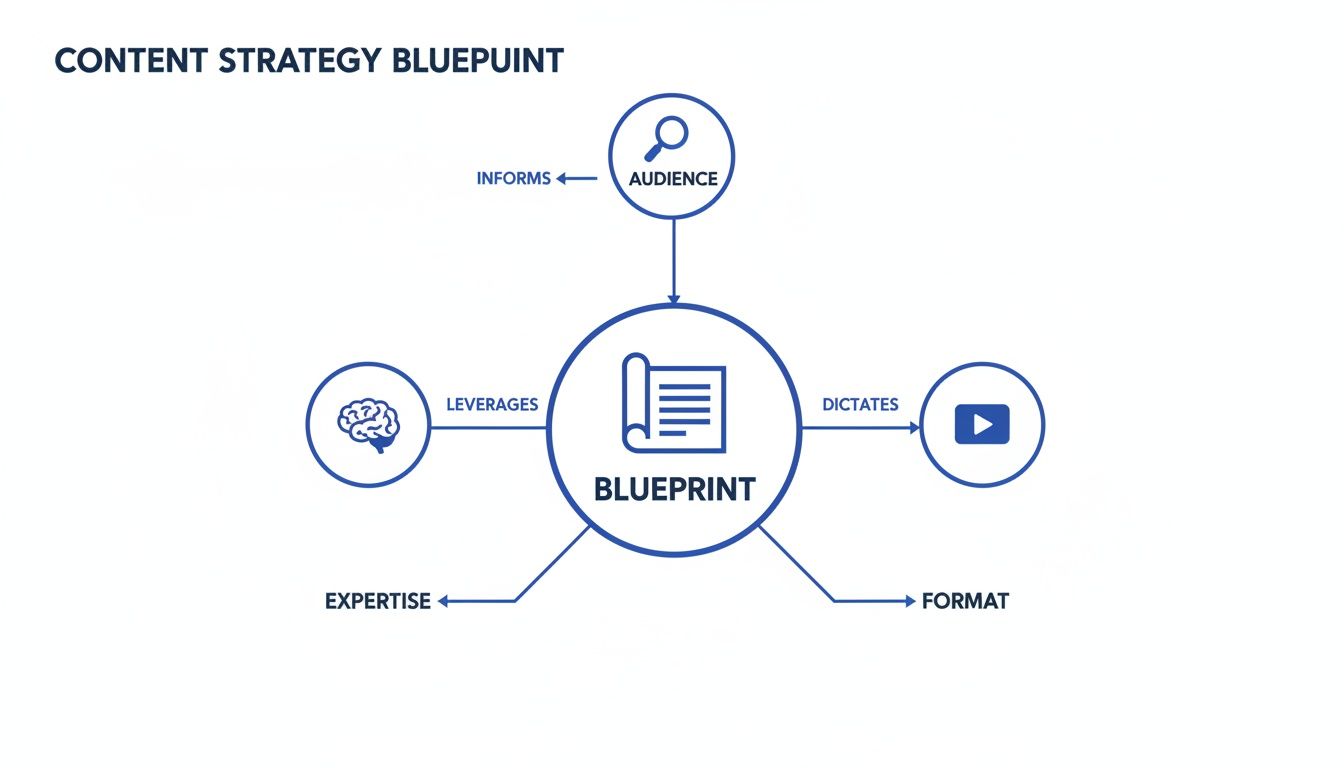
A winning plan always lives at the intersection of who you serve, what you know, and how you share it. Let's break down how to build this for yourself.
Start with Your Ideal Client Profile
Before you write a single word, you have to know exactly who you're writing for. If you try to talk to everyone, you’ll connect with no one. This is where creating an Ideal Client Profile (ICP) comes in—it’s the first and most critical step.
Picture one specific person who represents your absolute best client. Go deeper than just demographics. What are their biggest headaches at work? What goals are keeping them up at night? What kind of content do they actually find useful, and what do they scroll right past?
By getting laser-focused on one person, your content instantly feels more personal and direct. It stops being a broadcast to a faceless crowd and starts feeling like a one-on-one conversation.
For example, a business coach for early-stage SaaS founders isn’t just targeting "entrepreneurs." A much better ICP would be: "Alex, a 32-year-old technical founder who just closed a seed round. He’s brilliant at product but struggles with delegating, and he's terrified of missing the growth targets his investors expect." Now, every piece of content is created to solve Alex's specific problems.
Define Your Core Content Pillars
Okay, you know who you’re talking to. Now, what are you going to talk about? Your content pillars are the 3-5 core topics that become the foundation of everything you create. These are the big-picture subjects where you want to be seen as the go-to expert.
Your pillars should be a perfect mix of what your audience needs and what you uniquely know. Don't pick generic topics. Zero in on areas where you have a strong point of view or real-world experience to back it up. For our coach targeting Alex, the pillars might look like this:
- Founder-Led Sales: Actionable playbooks for technical founders who need to close their first big deals.
- Team Scaling & Delegation: Simple frameworks for making those critical first hires and building systems that work.
- Investor Relations & Metrics: How to talk to investors, report progress, and manage expectations after that seed round.
These pillars give you structure. Instead of staring at a blank screen, you can just ask, "What can I share about Founder-Led Sales today that would help Alex?" This keeps your content sharp, relevant, and consistently reinforcing your expertise. If you want to dive deeper, you can learn more about how to develop a comprehensive content strategy framework in our detailed guide.
Choose Your Primary Content Formats
Last but not least, how are you going to get your message out there? The best format is one that plays to your strengths and matches how your audience likes to consume content. Not everyone is a great writer, and that’s totally fine.
Think about what feels most natural to you. Are you a visual thinker who can break down complex ideas with graphics? Carousels or short videos could be your sweet spot. Are you a great talker? A podcast or an interview series might be perfect. And if you're an efficient writer, text posts and articles are still incredibly powerful.
The key is to choose 1-2 primary formats to master at the beginning. Trying to juggle text posts, carousels, videos, and a podcast from day one is a guaranteed recipe for burnout. Start small, get consistent, and then you can start expanding your formats as you see what your audience loves.
Turning Your Expertise into Consistent LinkedIn Content
Having a framework is great, but the real grind is consistently feeding that machine with good ideas. I've seen so many brilliant founders, consultants, and freelancers just freeze up when they see a blank screen. Their heads are crammed with incredible expertise, but the pressure to be a "writer" is paralyzing.
Here's a thought: what if you could just bypass the blank page entirely? A smart content strategy isn't about forcing yourself to write; it's about building systems that make sharing what you know feel natural. The goal is to get your knowledge out of your head and onto LinkedIn without all the friction.
The Interview-to-Post Method
Imagine someone pulls you aside and starts interviewing you about what you do best. There's no pressure, no perfect sentence structure required—you just talk. You explain things, tell stories, and give advice like you would to a client. That natural, conversational flow is the secret behind the Interview-to-Post method.
This whole system is built for busy experts who know their stuff but aren't professional writers. It plays to your biggest strength: your ability to talk confidently about your work. By starting with your spoken voice, you dodge writer's block and tap directly into your most authentic self.
The process itself is ridiculously simple:
- Record Your Thoughts: Grab your phone and use a voice memo app. Seriously, that's it.
- Transcribe the Audio: Use an AI transcription service to dump your recording into a text file.
- Mine for Gold: Scan the transcript and pull out key phrases, stories, and killer insights.
- Draft and Polish: Use these raw nuggets to build several LinkedIn posts, cleaning them up for clarity.
A single 15-minute recording can easily become a full week of solid content. It's an efficient little engine that makes consistency possible, even when your calendar is a nightmare.
Prompts to Get You Talking
The magic of a good recording session always starts with a good prompt. The right question can unlock a firehose of insights you'd never think to just sit down and write. So, instead of asking, "What should I post today?" try asking yourself a question that sparks a real conversation.
Here are a few prompts to get you started on your next recording:
- What's a common myth in your industry you love to bust? Explain what people get wrong.
- Walk me through a recent client challenge. Talk about the problem, your process, and the win.
- What’s the one piece of advice you’d give someone just starting out? Share a lesson you learned the hard way.
- Talk about a mistake you made and what it taught you. Nothing builds trust like a little vulnerability.
- What's a counterintuitive belief you have about your industry? These are the takes that get people talking and position you as a real leader.
When you frame content creation as an interview, you take off the "writer" hat and just let your expertise flow. You're not creating from scratch anymore; you're just documenting what you already know.
From Raw Transcript to Polished Post
Once you have your transcription, the next job is to shape that raw material into something ready for LinkedIn. This is where modern tools can really speed things up. Platforms like PostFlow are built for this exact workflow, using AI to help you turn those jumbled thoughts into structured drafts.

This setup shows how you can move from raw notes to a polished draft with a live preview right there. It turns the hardest part of content—getting ideas out of your head and into a coherent format—into a repeatable system. That's how you turn abstract expertise into tangible posts that actually build your brand and connect with your audience, week after week.
Mastering LinkedIn Formats for Maximum Reach
Creating powerful content is only half the battle. If you want to win on LinkedIn, you have to package it correctly. I’ve seen countless brilliant ideas fall flat simply because they were squeezed into the wrong format and got lost in the feed.
To get ahead, your content strategy needs to work with the LinkedIn algorithm, not against it. That starts with picking formats that grab attention and, more importantly, drive real engagement.
Think of it this way: your core message is the engine, but the format is the vehicle. A race car engine won't do you much good if you stick it in a rowboat. The same principle applies here. A deep, technical breakdown will die a slow death as a quick text post, but it could absolutely crush it as a detailed carousel.

Carousels for Educational Storytelling
Right now, carousels (or document posts) are one of the most powerful formats on LinkedIn, especially if you’re a consultant, founder, or creator. Why? They’re masters at breaking down complex topics into simple, digestible steps.
Instead of hitting your audience with a wall of text, a carousel guides them through a visual story, one slide at a time. This encourages people to swipe through, which is a huge engagement signal to the algorithm and can give your post's reach a serious boost.
Use carousels to:
- Showcase a step-by-step process: Walk people through a framework or a problem-solving method they can actually use.
- Repurpose longer content: Turn a key section of a blog post or a webinar into a visually engaging summary.
- Share data or key takeaways: Present stats or surprising insights in a clean, graphical way that’s easy to understand.
A great carousel doesn't just share information; it teaches. It creates a "micro-learning" moment that leaves your audience feeling smarter, building your authority with every single swipe.
Short-Form Video for Immediate Attention
Nothing stops the scroll quite like video. A well-made short-form video (think under 90 seconds) can communicate your personality and expertise faster than anything else. It's your chance to speak directly to your audience and build a genuine connection.
The trick is value density. You only have a few seconds to hook someone. Kick things off with a strong statement or a compelling question that hits a major pain point for your ideal client. For a deeper dive into structuring your posts, check out our guide on how to format LinkedIn posts for engagement.
The Power of Simplicity: Text and Image Posts
Never, ever underestimate the impact of a simple, well-crafted text-and-image post. They might not be as flashy as carousels or video, but these posts are incredibly versatile and amazing for starting conversations and sharing relatable insights.
The best ones often combine a personal story or a counterintuitive take with a high-quality, relevant photo. The image grabs the eye, and the text provides the hook that reels them in. This format is perfect for sharing personal lessons, industry observations, or asking thought-provoking questions to get your network talking.
When choosing a format, it helps to know what performs best on average. While individual results vary, certain formats consistently deliver higher engagement.
LinkedIn Post Format Performance Comparison
| Post Format | Average Engagement Rate | Best Use Case |
|---|---|---|
| Carousel/Document | 3.5% - 6.0% | In-depth educational content, tutorials, and data visualization. |
| Video Post | 2.5% - 4.5% | Building personal connection, behind-the-scenes content, quick tips. |
| Text & Image Post | 2.0% - 3.5% | Storytelling, asking questions, sharing personal insights or wins. |
| Text-Only Post | 1.5% - 3.0% | Quick thoughts, controversial takes, and conversation starters. |
| Polls | 4.0% - 7.0% | Quick audience feedback, market research, and sparking debate. |
As you can see, carousels and polls often lead the pack in engagement, but a simple text-and-image post still holds its own. The key is to mix it up based on your message and your goals for that specific piece of content.
The Unwritten Rules of LinkedIn Engagement
Choosing the right format is a huge step, but your posting rhythm and interaction habits are just as crucial. The algorithm rewards two things above all: consistency and genuine community participation.
Frequency and Timing
Aim to post 3-5 times per week. This keeps you top-of-mind without spamming your audience’s feed. The "best" time to post can vary, but generally, mid-morning on weekdays (Tuesday-Thursday) is a solid bet as people are settling into their work day.
Strategic Commenting
Your visibility isn't just about what you post—it's also about where you show up. I recommend dedicating 15-20 minutes every day to leaving thoughtful comments on posts from industry leaders and your ideal clients.
A meaningful comment that adds to the conversation does more for your visibility than a dozen likes ever will. It puts your name, face, and expertise directly in front of a relevant, engaged audience. It’s one of the most underrated growth hacks on the platform.
Measuring Success and Optimizing for Growth
Putting content out there without tracking what it does is like flying a plane with no instruments. Sure, you feel like you're moving, but you have no clue if you're actually headed in the right direction. A solid digital content strategy isn't just about shipping posts; it's about shipping posts that deliver real business outcomes.
To do that, you have to stop chasing vanity metrics and start focusing on what actually moves the needle. Likes and comments feel good, but they don't pay the bills. The real wins are the actions that signal someone in your target audience is genuinely paying attention.
Moving Beyond Vanity Metrics
It’s incredibly easy to get hooked on the dopamine hit from a post that blows up. Hundreds of likes can feel like a huge success, but if none of those likes come from potential clients or spark a real conversation, it hasn't actually done anything for your business.
This is where a data-driven strategy comes in. It prioritizes Key Performance Indicators (KPIs) that are directly tied to growth. These are the numbers that tell you a story about your reputation and your sales pipeline.
Here’s how to shift your focus from vanity to value:
- Instead of Likes, track Profile Views: A jump in profile views, especially from people in your target industry or role, means your content is catching the right eyes.
- Instead of Reach, track Inbound Connection Requests: When your ideal prospects start sending you connection requests with personalized notes, that's a crystal-clear sign your expertise is hitting home.
- Instead of Comments, track Direct Messages: A comment is public performance, but a DM is a private conversation starter. Tracking DMs that turn into discovery calls is one of the most powerful KPIs you have.
When you zero in on these outcomes, you draw a straight line from your content efforts to tangible business results. This is how you turn your LinkedIn profile into a predictable engine for generating leads.
Using LinkedIn Analytics to Your Advantage
LinkedIn gives you a surprisingly powerful set of native analytics to work with. Don't let that data sit there collecting dust. A quick glance at your post analytics can tell you exactly which content pillars and formats are getting the job done.
A common mistake I see is treating all content like it's the same. The data will scream at you that a certain style of carousel or a particular type of video consistently crushes everything else. Your only job is to listen and double down on what’s working.
For instance, you might find that your posts about "Founder-Led Sales" get double the engagement of your other topics. That’s your audience telling you exactly what they want more of. Or maybe you notice your carousels drive way more profile clicks than simple text posts, which should immediately inform your content plan for next month.
Creating a Simple Monthly Review Framework
Optimization isn't something you do once; it's a constant cycle of learning and tweaking. To keep it from becoming overwhelming, just set up a simple monthly content review. Block out one hour at the end of every month to see what worked, what didn't, and what you’ll do next.
Follow this dead-simple process:
- Review Top-Performing Posts: Pull up your top three posts from the last 30 days. Look at impressions and engagement, but most importantly, look at the business metrics we just talked about.
- Identify Patterns: What do these posts have in common? Was it the topic (pillar)? The format (carousel, video)? The hook you used in the first line? Find the thread.
- Analyze Underperforming Content: Now look at the duds. Was the topic too niche? Was the format a poor match for the message? Get honest about what failed to connect.
- Set Priorities for Next Month: Based on what you just learned, decide what to do more of and what to stop doing. Maybe that means creating two more carousels on your most popular topic or trying out a new hook style.
This simple review turns content creation from a guessing game into a clear, data-backed plan. If you want to get even more granular, check out our full guide on how to analyze content performance to build a repeatable system for growth. Continuously measuring and optimizing is what takes your digital content strategy from pretty good to genuinely great.
Common Questions About Digital Content Strategies
Even with a solid plan, jumping into the world of content strategy can feel a bit daunting. Totally normal. I've seen founders, freelancers, and consultants all hit the same walls when they start getting serious about building their presence on LinkedIn. Let's tackle some of the most common questions head-on with answers you can actually use.
Think of this as your personal troubleshooting guide. These are the real-world fixes for the challenges that pop up the moment you try to turn that beautiful strategy document into daily action.
How Do I Create a Content Strategy if I Am Not a Writer
This is probably the biggest mental block I see. The good news? You don't have to be a professional writer to win at content. Your expertise is the real currency here, and your strategy should be about sharing what you already know, not trying to write the perfect sentence.
Lean into frameworks that help you skip the blank page entirely, like the 'Interview-to-Post' method we talked about earlier. Just start by recording yourself answering the questions your clients always ask or explaining a concept you know like the back of your hand. Your genuine voice and deep knowledge will connect with people far better than perfectly polished but soulless content ever could.
The big mindset shift is from "writing" to "sharing." Let your expertise do the heavy lifting, and use simple systems to get it out of your head and in front of your audience. You're an expert who shares, not a writer who has to become an expert.
How Much Time Should I Dedicate to Content Each Week
Consistency always, always beats short bursts of intensity. A classic mistake is going hard for one week, burning out, and then ghosting your audience for a month. A real content strategy that works is built on a rhythm you can actually stick with.
Aim for 2-4 hours per week, but break it down into small, focused chunks. This keeps content from feeling like a monster of a task looming over you. Here's a simple way to break it down:
- Hour 1 Batching Ideas: Block out an hour to just record your thoughts for the week, maybe riffing off a few prompts.
- Hour 2 Drafting: Take that recording and use a tool to help you pull out and clean up a few post drafts.
- Daily 15 Minutes Engagement: Spend just 15 minutes a day scheduling your post and jumping into conversations in your network.
A smart system makes this a sustainable habit, not another chore. The whole point is to find a flow that keeps you visible without taking away from the core work that pays the bills. That’s the kind of consistency LinkedIn's algorithm loves to see.
What if I Run out of Content Ideas
Ah, the fear of the empty idea well. It’s real, but having a solid framework makes it pretty much a non-issue. Your content pillars are your best friend here and your first line of defense against writer's block.
When you feel stuck, go right back to your core framework. For each of your 3-5 content pillars, make a running list of the top 10 questions your clients ask you. Boom. You've just created a list of 30-50 post ideas that you know are relevant to the people you want to attract.
From there, you can pull from other sources:
- Document Your Work: Stop trying to create content and start documenting what you’re already doing. Share a challenge you just solved for a client, a lesson you learned on a project, or a quick insight from a call.
- Listen to Conversations: Pay attention to what's happening in your LinkedIn feed. What are people in your industry debating? What questions are prospects asking in the comments of other people's posts? Add your two cents.
- Repurpose Existing Assets: Got a webinar recording? A sales deck? A case study? Each one of those is a goldmine of smaller ideas you can break down into individual posts.
When you have a system, your daily work and the conversations around you become an endless well of great content ideas.
How Long Until a Content Strategy Shows Results
Look, building real authority and trust is a marathon, not a sprint. You might see some nice little bumps in engagement within the first 30 days, but the results that really move the needle—like a steady stream of inbound leads—usually start showing up after 3-6 months of consistent, focused effort.
It's so important to set the right expectations and keep your eyes on the right signals early on. Don't get bummed out if your inbox isn't overflowing with new clients after a month. Instead, track the leading indicators that tell you you're on the right track.
These are the small wins that prove the bigger ones are coming:
- Increased Profile Views: Are more of the right people from the right companies checking you out?
- Inbound Connection Requests: Are ideal clients reaching out to connect with you?
- Quality Conversations: Are your posts and comments sparking DMs that turn into actual business conversations?
These metrics show your strategy is working long before the big pay-off arrives. Trust the process, stay consistent, and let the momentum build.
Ready to stop guessing and start building a repeatable system for your LinkedIn content? PostFlow is your AI content strategist, designed to turn your expertise into consistent, authority-building posts. Let Emilia interview you, extract your best ideas, and draft content that sounds like you—only faster.
Start turning your expertise into opportunity with PostFlow today.